
By Automotive Research TeamUpdated 2026-09-21
Engine repair: find the failure before the quote
Engine repair is the decision that comes after the failure has a name. A dark stain on the driveway, oil that looks like coffee with milk, a light on the dash, and coolant that vanishes are four different jobs. They should not share one quote. This guide sorts those cases at the engine before anyone talks about a rebuild, a used engine, or a computer.
The useful question is not "how bad is it." The useful question is which system is losing what. Oil on the ground is a sealing problem until a pressure light says the bearings are already dry. Coolant in the oil is a sealing problem between the cooling jacket and the crankcase, and that seal can be a gasket or the casting itself. A warning light with no leak is often a report from the computer, and the report is not the same thing as a dead computer. Name the case first. Then the repair has a scope.
Nothing below is a torque chart or a price. Measurements that appear here are copied from the document that published them, and they apply to the engines that document covers. If your car is not in that list, the number is an example of how a manufacturer decides, not a specification for your block.
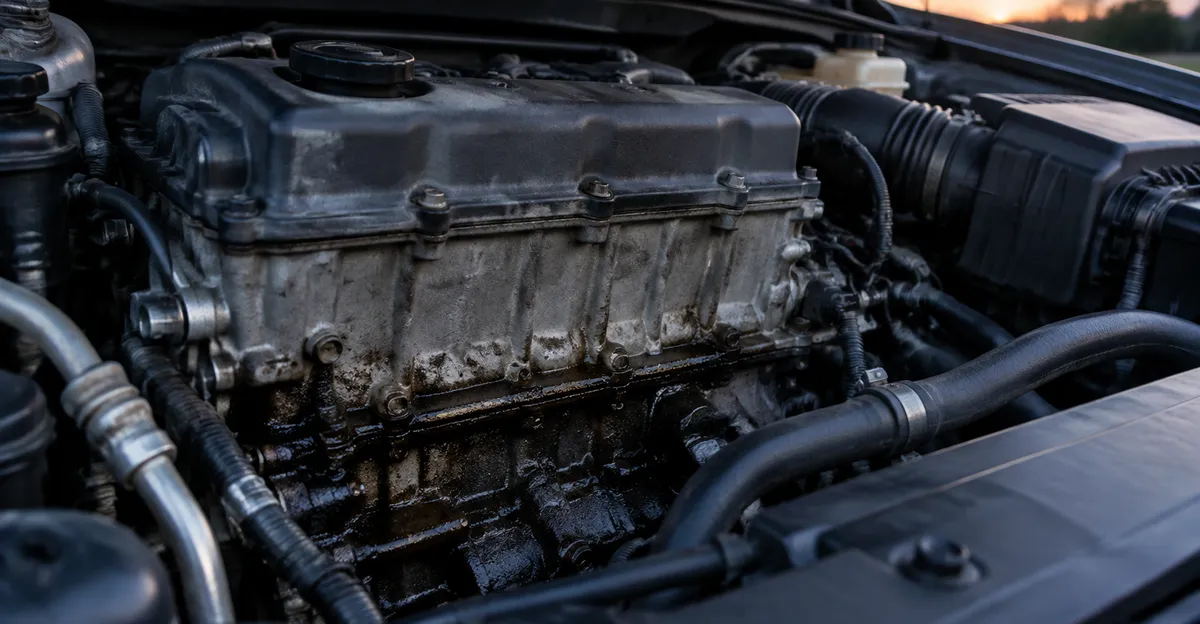
Sort the failure before anyone quotes parts
Car engine repair is a label shops put on several failures that only look alike from the driver's seat. The stain, the smoke, the light, and the temperature gauge do not point at the same part. A quote that skips that sort is a quote for a job that may not be the one in the car.
Start with the fluid, not with the part name you hope it is. AAA's leak guide, published by AAA Club Alliance, treats the oil stain as the most common wet patch under a car. The fluid is dark. It stains concrete. AAA calls a minute amount of oil normal, and calls a large puddle, or an engine that is consistently low, a reason to fix it immediately. Running low on oil, or with none, can cause serious damage that does not come back. AAA's identification for that fluid is black, amber, or brown, thick, and a burnt smell close to cooking oil. The places they name are the oil pan, the valve covers, and the gaskets and seals.
That description is how you tell oil from the other puddles AAA lists on the same page. Air-conditioning condensate is clear, watery, and odorless, and it shows up after the air conditioning has been running. Washer fluid is thin and smells like glass cleaner. Fuel is thin, smells like gasoline, and a puddle of it is a fire risk AAA says to resolve rather than drive on. Brake fluid is slippery, slightly fishy, and AAA says to tow if you can, because the car is losing the ability to stop. Transmission fluid and power-steering fluid can both be red or brown. Oil is the thick, dark, burnt one. If you cannot tell, AAA's own close is to take it to a mechanic instead of guessing.
Coolant leaving the reservoir is a different complaint, and it does not belong in the oil-stain column. General Motors customer satisfaction program 15638, from October 2015, describes one head-gasket failure on a short list of 6.2L trucks and a Corvette. The symptoms GM wrote down were a check-engine light for misfire code P0300, combustion gas in the coolant, overheating, an overflowed coolant bottle, milky oil in the crankcase, and piston scuffing. GM said that if the vehicle kept being driven in that condition, the engine could fail. The correction in that program was to replace both head gaskets, not to add a sealer and send the owner home. GM also printed the standard warning on the bulletin: do not assume the bulletin applies to your vehicle. The population was thirteen vehicles. The symptom list is still the cleanest official description of what a gasket leak into the combustion chamber and the oil can look like.
A light with no puddle and no milky oil is the third column. General Motors service bulletin 20-NA-144, July 2020, covers a check-engine light with code P0606 stored in the engine control module on certain 2016 and 2017 cars with a stop-start system. The complaints GM listed were the light, a no-start, reduced propulsion, and a stall. The cause they named was a possible software fault. The instruction to the dealer was explicit: do not replace the engine control module, reprogram it. A computer quote, before a scan, is how that job gets sold as hardware.
Use the three columns before you approve anything.
| What you notice | What it usually is | First check |
|---|---|---|
| Dark stain, thick fluid, burnt smell | External oil past a gasket, seal, pan, or valve cover | Dipstick level, then whether it drips or only films the case |
| Milky oil, coolant loss, overheating, misfire light | Combustion or coolant crossing a head gasket, or a crack | Stop driving. Pressure-test. Do not keep topping off |
| Light on, no leak, may crank and stall | A code in the control module, sometimes software | Scan and save the code before anyone orders a module |
| Clear odorless puddle after the air conditioning ran | Condensate, not an engine failure | Confirm it is water and odorless, per AAA |
The table is a sort, not a diagnosis. Two of these can be true on the same car. Oil on the outside of a pan does not rule out a gasket that is also putting coolant in the oil. A light can be on because the engine is misfiring from that gasket, which is the P0300 case GM described, or because the module itself reported P0606, which GM treated as software. The code number is the split. Without the code, the light is only a light.
What an engine repairman is paid to decide
The person you hire is paid to name the failed part and to refuse the jobs that are not that part. The decision has a shape. Find where the fluid or the code starts. Match it to a component. Repair that component. Prove the leak or the code is gone. A visit that skips the first step and jumps to a rebuilt long-block is not a harder version of the same job. It is a different job, and it is the wrong one if the failure was a valve-cover gasket or a calibration.
Ask what will be identified before parts are ordered. On an oil complaint, the answer should be the highest wet point, not "the engine is leaking." Oil runs down. A wet pan is often the landing place for oil that left a valve cover, a sender, or a front cover higher up. Lexus service bulletin L-SB-0002-20, revised August 5, 2020, draws the line the shop should be using. A leak is pooling fluid that forms droplets and drips. A seep is a thin film or a damp, darker coat that may hold dust. Lexus says seepage at a mechanical joint is normal, does not require repair, and should be written on the repair order and looked at again at the next service. A quote to reseal a timing cover because the paint looks dark is a quote Lexus's own definition does not support, on the Lexus models that bulletin covers. The bulletin applies to powertrain fluids other than fuel and coolant, across a long list of 2000 to 2021 Lexus cars. It is a definition you can ask any shop to apply, and then you can ask them what their manufacturer says if the car is not a Lexus.
Ask what will not be replaced. A head-gasket job that does not include a check of the head and the block face is a gasket thrown at a crack or a warped surface. GM's program replaced both gaskets and told technicians to install new torque-to-yield bolts, because those bolts are single-use. Reusing them can leave the clamp load wrong. That detail is in the bulletin's fastener caution. It is also a reason the job is not "a gasket and an afternoon." GM published labor times for that specific program: 14.3 hours on the Corvette, 11.3 hours on the Silverado and Sierra, 9.9 hours on the Escalade and Yukon, both sides. Those times are not a price, and they are not your car unless it is one of those thirteen. They show that the manufacturer treated the repair as head removal, not as a bottle of sealer.
Ask what proof you get at the end. Lexus requires, for a warranty leak repair, photographs of the active leak taken before the repair starts, clear enough to show the component and a close view of the defect. You are not filing a Lexus warranty claim. You can still ask for the same thing: a photo of the drip before the engine is cleaned, and a confirmation drive after, with no fresh drip from the joint that was opened. Lexus's close-out step is a test drive that confirms the repaired area is dry.
The work you should not expect on the spot is a cracked-block verdict from a glance at the dipstick. Milky oil means coolant and oil have met. It does not say whether the path was the gasket GM described or a crack in the casting. That split is a pressure test and, if the heads come off, a look at the casting. Paying for the test is the job. Paying for an engine because the oil looked wrong is a guess.
The checks that come before parts
A lookup written as engine+repair is the same decision as the headline: name the failure, then repair that failure. The checks below are the ones that change the name. They are driveway checks. They are not a teardown.
Read the oil level before you add a quart and forget the amount. AAA's instruction for a known oil leak is to top up and track how fast it leaves. A leak you can keep up with by checking the dipstick on a schedule is not the same urgency as a leak that drops the level between short trips. AAA is direct about the bottom of that scale. Low oil, or no oil, can ruin the engine. If the pressure warning comes on, or the engine sounds like metal on metal, the tracking phase is over. Park it.
Read the oil's look, not only its level. GM's gasket bulletin called out milky oil in the crankcase together with coolant loss and overheating. Oil that is gray, thick, and no longer looks like oil is a reason to stop, not a reason to add a quart of fresh oil and hope the color returns. Fresh oil hides the evidence and does not close the path the coolant is using.
Read the temperature gauge and the coolant bottle before a long drive. An overflowed bottle and a gauge that climbs are on GM's symptom list for that gasket program, next to combustion gas in the coolant. Combustion gas in the coolant is not something you confirm by smelling the reservoir and declaring it. A shop pressure-tests the system and can use a combustion-gas test. Your part is to notice the loss and the heat, and to stop adding coolant as a substitute for that test.
Read the warning lights and write down the behavior. A steady light with the car running normally is a stored code until a scan tool says otherwise. A flashing light with a misfire is the P0300 pattern GM tied to a gasket that had started to leak into a combustion chamber, and it is also the pattern other misfire bulletins treat as a reason not to keep driving. Do not clear the light to see if it comes back. Clearing it throws away the freeze frame a technician uses to see at what temperature and load the code set.
Look at the exhaust only as a clue, not as a part to buy. Blue smoke and a burning smell go with oil that is getting into the combustion chamber or onto a hot exhaust part. White smoke that continues after warmup, with the coolant going down, belongs in the gasket-or-crack column. A puff of white on a cold start that goes away is not that column. AAA's condensate note is the other white, odorless water, and it drips under the car rather than pouring from the tailpipe as a continuous cloud.
Separate seep from leak before you approve a reseal. Lexus defines the leak as droplets and a drip, and the seep as a film. If the underside is damp and dusty but the level on the dipstick does not move over a week of normal driving, you may be looking at the condition Lexus says to record and recheck, not to open. If you see drops on the bolt heads or a fresh spot on the concrete after the car sat, you are in the repair column. Photograph it before anyone washes the engine. A washed engine hides the path, and the next wet line may be oil that was already on its way down.
Fix car engine
Fixing it, in the sense of choosing a first action, is the check that matches the column. It is not a list of parts to throw at the engine.
If the complaint is external oil, clean nothing yet. Note the color against AAA's black, amber, or brown. Note whether you can see a drip. Check the level. If the level is in range and the mark is a film, book a diagnosis and keep an eye on the level. If the level is falling fast, or the pressure light is on, stop driving and have it towed. Topping up a pouring leak so you can "make it to the shop" is how a small seal job becomes a bearing job. AAA's line about irreparable damage is the reason.
If the complaint is milky oil or disappearing coolant with heat, do not keep driving to "see if it gets worse." GM already described the worse case: piston damage and engine failure when that gasket leak was ignored. Have it towed. Tell the shop you want a cooling-system pressure test and a look at the oil, not an estimate for a used engine as the opening move.
If the complaint is a light and the car still runs, do not buy a control module. Have the codes read and saved in every module the scan tool can see, and ask whether a manufacturer bulletin tells the dealer to program the module instead of replacing it. Bulletin 20-NA-144 is one case where GM answered that question with a no on replacement. Your code may not be P0606, and your car may not be on that list. The pattern is the same: the code is evidence, and the service manual says what the evidence means.
If you smell fuel, or the puddle smells like gasoline, treat it as the fire risk AAA described. Do not look for a spark, do not keep cranking, and do not drive it to the shop.
Leaks, gaskets, and the computer
These three are the jobs people collapse into one estimate. They share an engine bay. They do not share a repair.
Car engine oil leak repair
An external oil leak is a joint that no longer holds oil inside the engine. AAA puts the evidence on the pan, the valve covers, and the gaskets and seals. The repair is the joint that is actually wet at the top of the trail, plus the steps the manufacturer requires so the new joint does not leak again.
Lexus bulletin L-SB-0002-20 is the clearest published version of those steps, and it is written for technicians, not for a driveway gasket swap. After the leaking part is apart, every sealing surface is cleaned, inspected, and prepared before it goes back together. For a gasket, O-ring, or seal, that means all of the old material comes off, the surface is checked for pits, grooves, and gaps, and the part is replaced if the surface is damaged. Oil residue comes off. The surface is wiped with the proper cleaner and allowed to dry. A new gasket goes on, and the parts go together the way the repair manual says.
For a joint that uses form-in-place sealant instead of a cut gasket, Lexus is stricter about time. All old sealant comes off. The surface is inspected the same way. Oil comes off with a cleaner and a cloth that is free of oil. The surface dries before any new sealant is applied. The new sealant goes on, and the parts are assembled within three minutes. Oil stays out of that engine for at least two hours after the joint is closed. Then the car is test-driven, and the repaired area is checked for a fresh leak.
Those times are Lexus times for the joints that bulletin covers. Another manufacturer can specify a different sealant, a different open time, and a different wait before the oil goes back in. The principle they are protecting is the same. A surface that still has oil or old sealant on it will not seal, and a new gasket on a pitted surface copies the leak you just paid to remove. This is why "just put a gasket in" fails when the pan rail or the cover is the part that is damaged.
The other failure mode is repairing the wrong joint. Oil from a valve cover runs down the block and collects on the pan. A pan gasket replaced in that case does not stop the drip, because the oil never started at the pan. The photo Lexus wants before a warranty repair is the practical guard against that. The drip, the droplet on the bolt, the wet sender: that picture is the scope. A dark film with dust on it, and a level that holds, is the seep Lexus says not to open.
Track consumption the way AAA describes while you wait for the appointment, if the leak is small and the level is stable enough to drive. Top up. Write down the date and the amount. A leak that accelerates is a reason to stop using the car, not a reason to wait for a convenient opening. A severe leak, a pressure warning, or noise from the bottom end is a tow.
Car engine head gasket repair
A head gasket is the seal between the cylinder head and the block. It keeps combustion in the cylinder, coolant in the jacket, and oil in its passages. When it fails, those three can mix. GM's program 15638 is a narrow case, a stopper ring that was in the wrong place on certain 6.2L gaskets, and it is a useful picture of the failure because GM wrote the symptoms and the correction in one place.
The symptoms were a misfire light, code P0300, combustion gas getting into the coolant, overheating, a coolant bottle that overflowed, milky oil, and scuffed pistons. The correction was to remove both cylinder heads and replace both gaskets, using the service manual procedure, and to install new torque-to-yield bolts. GM's caution on that bulletin says those fasteners are single-use. The coating and the torque sequence matter. Paints, lubricants, and corrosion inhibitors on the fastener or the joint change the clamping force unless the manual says to use them. The bulletin tells technicians to follow the published sequence. It also says the bulletin is not a do-it-yourself procedure.
Two limits matter if you are holding an estimate. First, GM told dealers not to assume the program applies just because the engine is a 6.2. Thirteen vehicles were involved, and the program end date was November 30, 2017. Your car's gasket can fail for a different reason, on a different engine, with a different repair. Second, the symptom list is what you report. You do not report "it needs a head gasket" unless a pressure test, a combustion-gas test, or the heads being off have shown that. Overheating alone can be a radiator, a fan, a thermostat, or a low coolant level from a hose. Milky oil alone can be a cooler, a crack, or a gasket. The combination GM listed is the reason to test, not the reason to buy an engine.
Continued driving is the part GM was explicit about. In that condition, the engine can fail. Piston scuffing was already on the list of what they expected to find. Adding coolant and finishing the week is how a gasket job becomes a replacement engine. If the gauge is in the red, the bottle is pushing coolant out, or the oil is milky, the next move is a tow.
A shop that quotes the gasket should say whether the heads will be checked for flatness and for cracks, whether the bolts are new, and what happens if the block face is damaged. A gasket on a cracked deck does not hold. That finding changes the job from a gasket to the block repair in the next section, and you should hear that before the heads are off only if a pressure test already proved it. Often the proof is the head removal itself. The estimate should say that the price can change when the castings are visible.
Car engine computer repair
The engine control module is the computer that runs fuel, spark, and the checks that turn the light on. Replacing it is a specific repair for a failed module. It is not the repair for every light, and it is not the first repair for a light that a bulletin attributes to software.
Bulletin 20-NA-144 is the example to keep in mind. On the 2016 and 2017 Cadillac ATS and CTS, and Chevrolet Cruze and Malibu, with the listed 2.0L or 1.4L engines and stop-start, a P0606 "control module processor performance" code could come with a light, a no-start, reduced power, or a stall. GM told dealers the cause might be a software anomaly, and told them not to replace the module. The correction was to reprogram it with the factory service programming system. After programming, the codes are cleared. GM noted that clearing powertrain codes sets the inspection and maintenance monitors to not ready, which matters for an emissions test done the same day.
The programming warnings are the reason this is not a download you do in a parking lot. GM says battery voltage has to stay stable. A spike, a drop, or a loss of voltage interrupts programming, and an interruption can damage the module. The dealer tool is a programming support tool that holds system voltage. If that tool is not there, GM allows a fully charged 12-volt jumper or booster pack that is disconnected from the wall. GM says not to connect a battery charger. Loads that pull on the battery — interior lights, exterior lights, the climate control, the radio — are turned off first. The computer that downloads the calibration is on a network cable, not wireless, because a dropped connection during the write can fail the programming or damage the module.
GM also printed the warranty boundary for that event. Reprogramming of the engine control module, under the coverage they cite, is 8 years or 80,000 miles in the United States, and 8 years or 130,000 kilometres in Canada. That is not a promise that your module is covered, and it is not a promise that every light is fixed by programming. It is evidence that the manufacturer treats a software repair as a module repair, and that they published a time and a coverage code for it. A shop that quotes a new computer for P0606 on one of those cars, without checking for the calibration, is quoting the repair GM said not to do.
On any other car, the same discipline applies without that bulletin's parts list. Read the code. Look up the code in the service information for that vehicle. See whether the test procedure ends at a wire, a sensor, a ground, or the module. Replace the module when the procedure says the module failed, and program the replacement, because a new module that does not have the car's calibration and immobilizer data often will not start the car. A used module from another car is a programming and anti-theft problem, not a cheaper version of the same part.
A misfire code is the trap between this section and the gasket section. P0300 was GM's gasket symptom in bulletin 15638, and P0606 was GM's module-software symptom in bulletin 20-NA-144. Both can turn on the same lamp. The digits after the P are the job. Write them down.
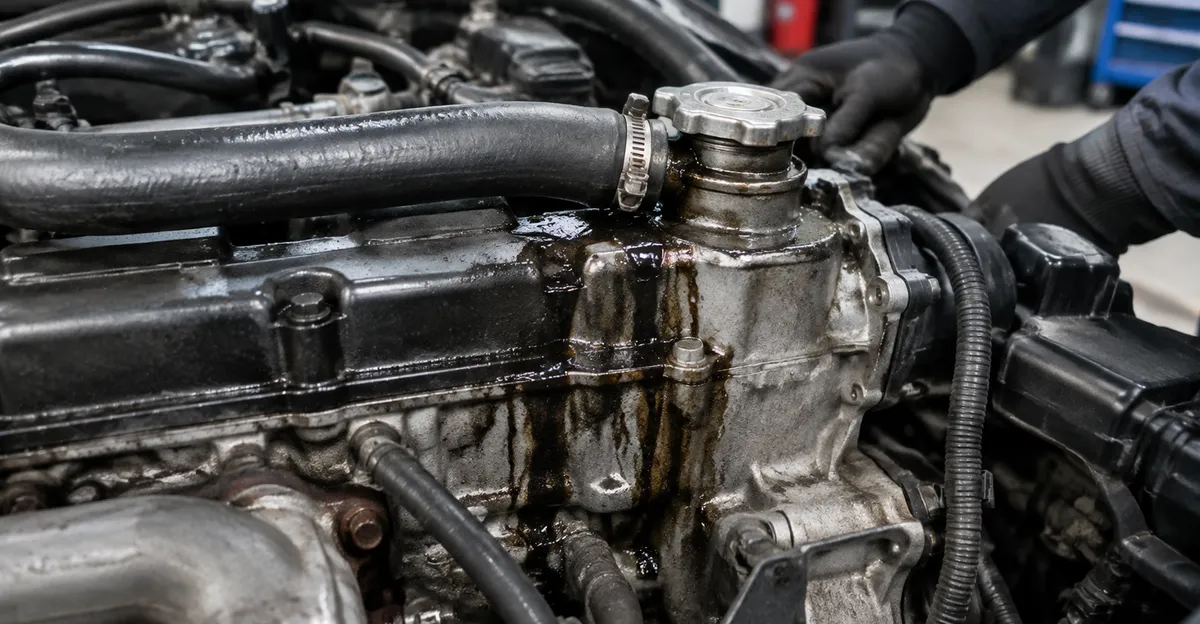
How to repair a car engine
How to repair car engine work is a sequence that stays the same after the failure has a name. The sequence is not a single procedure you can follow with a socket set on every car. Manufacturers publish the procedure for the joint, the head, or the module. The sequence is how you keep that procedure aimed at the right part.
Confirm the complaint on a cold engine and again after a drive, if it is safe to drive. A leak that only appears hot will not show on a cold inspection, and a seep that looks dramatic in a dusty engine bay may not form a drop. Lexus's definitions are the standard for that second look: droplets mean repair, a film means record it. AAA's color and smell checks keep you from sealing an oil pan because the air conditioning dripped clear water.
Isolate the source before parts are ordered. For oil, that is the top of the wet trail, photographed. For coolant in the oil or in the cylinder, that is a pressure test and a combustion-gas check, then the heads if the tests say the gasket or the casting is open. For a light, that is the stored code and the test in the service manual for that code. Write the finding in a sentence a second shop could read. "Customer states engine is bad" is not a finding. "Droplets at the oil-pressure sender, level falling between checks, no milky oil, no overheating" is a finding.
Repair the failed part the way the manual says, including the parts the manual says are single-use. GM's torque-to-yield bolts are the example. Lexus's new gasket on a dry, undamaged surface, and the three-minute assembly window for sealant, are the example for an oil joint. A programming event with stable voltage, a wired connection, and loads turned off is the example for a module. Substituting a shorter version because the long one costs more is how the leak, the gasket, or the module comes back.
Verify. Lexus ends the oil-leak repair with a test drive and a check that the joint stays dry. GM ends the programming repair by clearing the codes after a successful write. A gasket repair is verified by a cooling system that holds pressure, oil that stays oil, and a temperature gauge that stays off the red. If the verification fails, the job is not finished, and the next step is another diagnosis, not a second copy of the same part.
Know the stops. Fuel odor and a liquid that smells like gasoline: do not drive. Oil pressure warning or rod noise: do not drive. Milky oil with rising temperature: do not drive. A programming session you are tempted to finish on a weak battery: stop, because GM says a voltage loss can damage the module. Those stops are the difference between a repair and a larger one.
A cracked block is a different job
A crack is a path through the casting. Coolant can enter the oil or a cylinder without a failed gasket, and a new gasket on a cracked deck does not close that path. The driveway cannot see the crack. The tests can.
Do not start from a video of someone welding a block on a bench. Field welding is a salvage process with limits a manufacturer sets for that casting, in areas that are not structural, with preheat, filler metal, and inspection that a driveway does not have. Some service procedures do not allow the repair at all once the test finds a crack. That is the fact to take to the shop, not a technique to copy.
How to repair a cracked engine block
Detroit Diesel's Series 60 shop procedure is a clear published answer for one family of engines, and it should be read as that, not as the rule for a passenger car. In the repair-or-replacement steps for the cylinder block, the block is lifted into a tank and held for twenty minutes in water heated to 82 to 93°C, which Detroit also prints as 180 to 200°F. Air at 138 kPa, 20 psi, is applied to the water jacket. Bubbles in the tank mean a crack or a leak. Detroit's sentence after that observation is that a cracked cylinder block must be replaced by a new block.
A second check in the same section holds 138 kPa on the water jacket for at least two hours so a water-and-antifreeze mix can work through a crack. At the end, the liner-flange area, the oil passages, the crankcase, and the outside of the block are inspected for that mix. If it is there, Detroit again says the cracked block is replaced with a new block. There is no weld step in that procedure.
A passenger-car engine is not a Series 60. The number 20 psi and the tank temperature are not a test to run in a home garage, and they are not the pressure a cooling-system tester uses on a radiator cap. The useful part of the procedure is the decision rule. Prove the crack with a test the manufacturer recognizes. If the manual says replace, replace. If the manual allows a machined repair or a liner in a defined area, that is a machine shop following that manual, not a bead of weld across a coolant jacket.
On the car, before anyone talks about a bare block in a tank, the cooling system is pressure-tested in the chassis. GM, in the gasket program, already listed the signs that justify that test: coolant loss, overheating, overflow, milky oil, a misfire code. A pressure test that loses pressure at a hose, a radiator, or a water pump is not a cracked block. A pressure test that loses pressure into a cylinder or into the oil, with the external hoses dry, is the finding that leads to head removal and a look at the gasket and the castings. Head removal is expensive. It is still cheaper than an engine bought because the oil looked milky and nobody tested.
Ask the shop three questions if the word "crack" is in the estimate. What test showed the crack. Does the service manual for this engine allow a repair or require replacement. What is the cost of the test if the casting turns out to be intact and the gasket was the path. An estimate that cannot answer the first question is an estimate for a different failure than the one in the car.
If the block is cracked and the manual requires replacement, the repair is a block or a complete engine, plus the oil, coolant, and single-use hardware the procedure lists. It is not a sealer product poured into the radiator. Sealers are not in the Detroit replacement instruction, and they are not in GM's gasket correction. They can also plug a heater core or a radiator on the way through. That is a new problem, not a repair of the casting.
FAQ
how do you repair a cracked engine block
Detroit Diesel's Series 60 procedure does not repair the crack. It pressure-tests the block and replaces the block when the test shows one. The block is submerged for twenty minutes in water at 82 to 93°C (180 to 200°F). Air at 138 kPa (20 psi) goes into the water jacket. Bubbles mean a crack, and Detroit says to install a new block. A longer version of the test holds that pressure for at least two hours and looks for coolant at the liners, the oil passages, the crankcase, and the outside of the casting. The same sentence follows: replace the block.
That is a Series 60 instruction. It is not a weld procedure, and it is not the specification for the engine in a passenger car. On a car, start with a cooling-system pressure test. General Motors, describing a head-gasket leak on a small group of 6.2L engines, listed milky oil, coolant loss, overheating, an overflowed bottle, and a P0300 misfire as the reasons to take the heads off and replace the gaskets. A crack can look the same from the dipstick. The castings, once they are visible, and the service manual for that engine, decide whether the path was the gasket or the block. If the manual says the cracked block is replaced, a sealer in the radiator is not the repair Detroit or GM published.