
By Automotive Research TeamUpdated 2026-09-20
Why Does My Car Smell Like Gas: A Leak or a Spill
Why does my car smell like gas is a where-question before it is a parts question. Raw fuel vapor in the cabin, a whiff at the filler after a fill-up, and a wet spot on the ground are three different faults. One is often a cap or a vapor hose. One is liquid fuel near hot parts, and that one means the engine comes off before you hunt for the source.
This guide sorts the odor by place and by whether you can see liquid. It does not cover a sharp sulfurous odor from the tailpipe. That is a different fault, and it has its own page: the sulfur-smell guide. If what you smell is unmistakably raw fuel, stay here.
Why Does It Smell Like Gas in My Car
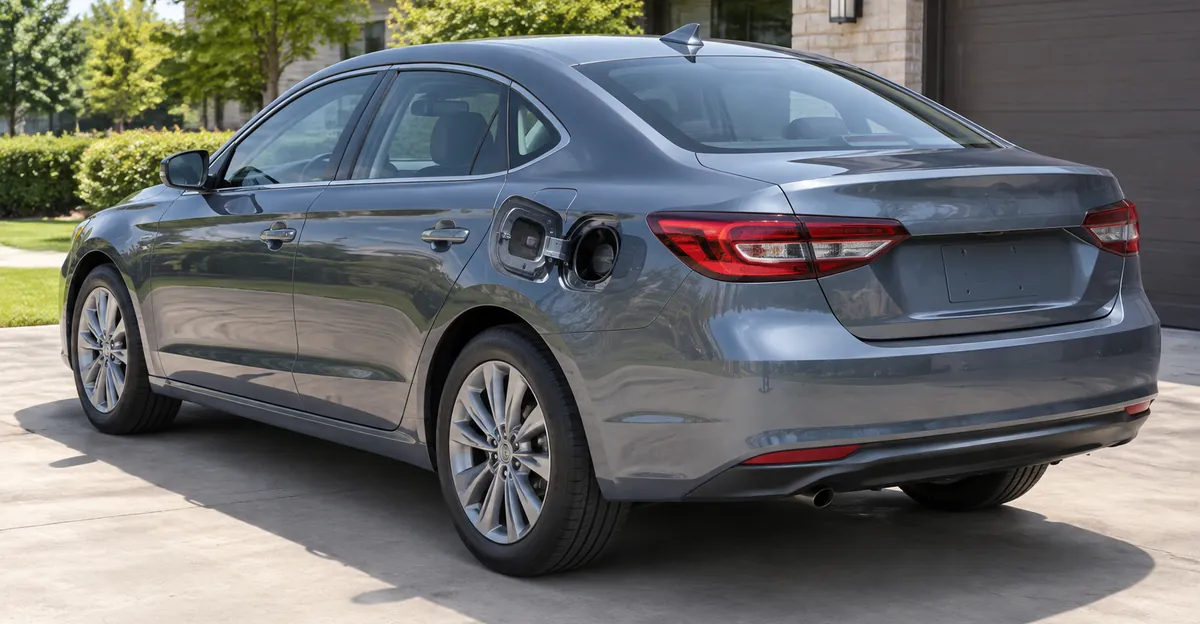
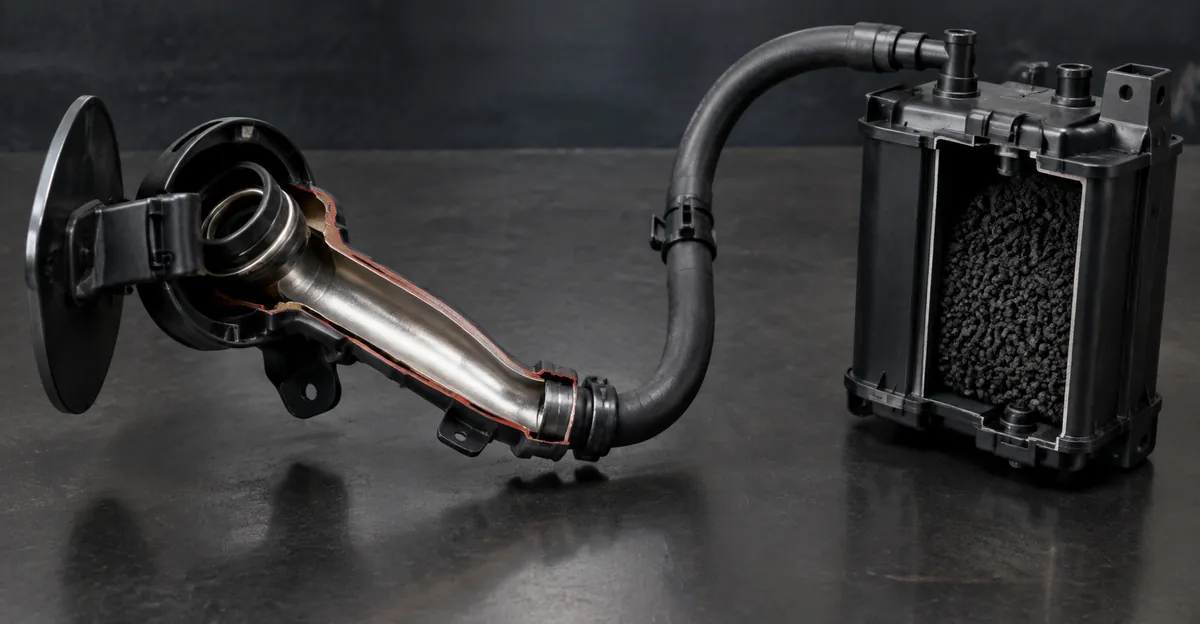
why does it smell like gas in my car is the same worry with the location already in the sentence: inside, with you. Car-X draws a useful line. An occasional fume is less alarming than a strong odor in the cabin, and a strong cabin odor should be looked at immediately. The cabin is not where fuel belongs. The system is built to keep vapor in a charcoal canister and burn it in the engine, not to share it with the seats.
Write down three facts before you drive anywhere.
- Where is it strongest: cabin, filler door, or under the hood?
- When did it start: the moment you left the pump, on a cold start, or all the time?
- Can you see liquid, or only smell vapor?
A smell with no puddle is often vapor. Endurance Warranty notes that modern cars capture and purge fuel vapor, so a leak in that circuit may not leave a puddle at all. A cracked hose, a purge valve that sticks open, or a charcoal canister that is full can release odor near the fresh-air intake. The blower then pulls it into the cabin even though the tank is dry on the outside.
A smell with a wet spot is liquid. Car-X says to look for puddles or drips under the car, especially near the engine or the tank, and not to drive if you suspect a fuel leak. Liquid fuel on a hot exhaust is a fire, not a smell to "see if it fades." Shut the engine off, get people away from the car, and have it towed. Do not use the cabin as the test chamber. If the odor is already strong with the windows up, opening them tells you it was trapped. It does not tell you the leak stopped.
The fresh-air test has a limit. Do it once, in a place you can pull over, with the engine already running. Do not circle the block to "get a better sample." A vapor leak you can live with for a short drive to a shop is not the same as a cabin that makes a passenger cough. If anyone feels ill, the test is over and the car stays off.
| Where you notice it | What it usually is | What to do |
|---|---|---|
| Cabin, no liquid, often with a warning light | Vapor from the cap or the evaporative system | Cap first, then a shop smoke-test if it stays |
| Filler door, right after a fill-up | Cap not clicked, seal torn, or the tank was overfilled | Click the cap. Do not keep topping off |
| Under the hood, or a wet trail on the ground | Liquid leak at a line, injector seal, or tank | Engine off. Tow it. See warning lights only after it is safe |
| With a hiss or a louder exhaust note | Exhaust leak letting fumes forward | Do not sit in a closed car with it running |
The cabin test is simple and it is not a repair. Windows down, blower on fresh air, then blower on recirculate. If the odor gets worse on fresh air, it is being pulled in from outside the cabin, often from the cowl or a leak ahead of the firewall. If it stays just as strong on recirculate, vapor is already inside, from the cabin floor, a damp mat, or a line under the car that soaked the underside. Tell the shop which way it went. That sentence saves a wrong hour of diagnosis.
Car Smells Like Gas
A car smells like gas for reasons that share a nose and not a repair. my car smells like gas is how most drivers say it once the odor is obvious. The shorter searches are the same odor: a gas smell in car, a fuel smell in car, a petrol smell in car, and a gasoline smell in car. People also type car smells gas and mean the identical thing. Treat those as one complaint. Sort them by the clues above, not by which word you used.
Endurance lists the usual vapor and liquid sources without pretending they look alike:
- A loose, damaged, or missing filler cap lets tank vapor out and often turns on an evaporative-system warning.
- A cracked evaporative hose, a purge valve that will not close, or a saturated charcoal canister releases vapor the engine was supposed to burn.
- Injector seals and fuel-rail O-rings seep when the system is pressurized. The smell can be strongest at startup, then fade as the drip burns off or evaporates.
- The tank or the pump module on top of the tank can seep at the rear. You smell it in the back seat more than in the dash, and you may not see a puddle if the seep stays above the tank shell.
Car-X adds the rich-running case. A fuel-pressure regulator that sticks can push too much fuel into the engine. The mixture goes rich. Mileage drops. The tailpipe may show black smoke. The cabin can smell like raw fuel even though no hose is dripping. You cannot see the regulator from the driveway. A shop measures fuel pressure. Do not replace a cap for black smoke.
None of these is a reason to spray the engine bay with water or to keep driving "to burn it off." Vapor you can smell is already a concentration your nose noticed. Liquid you can see is a reason to stop.
Right After a Fill-Up
The pump is the one place a fuel odor is ordinary for a few seconds. It stops being ordinary when it follows you down the road.
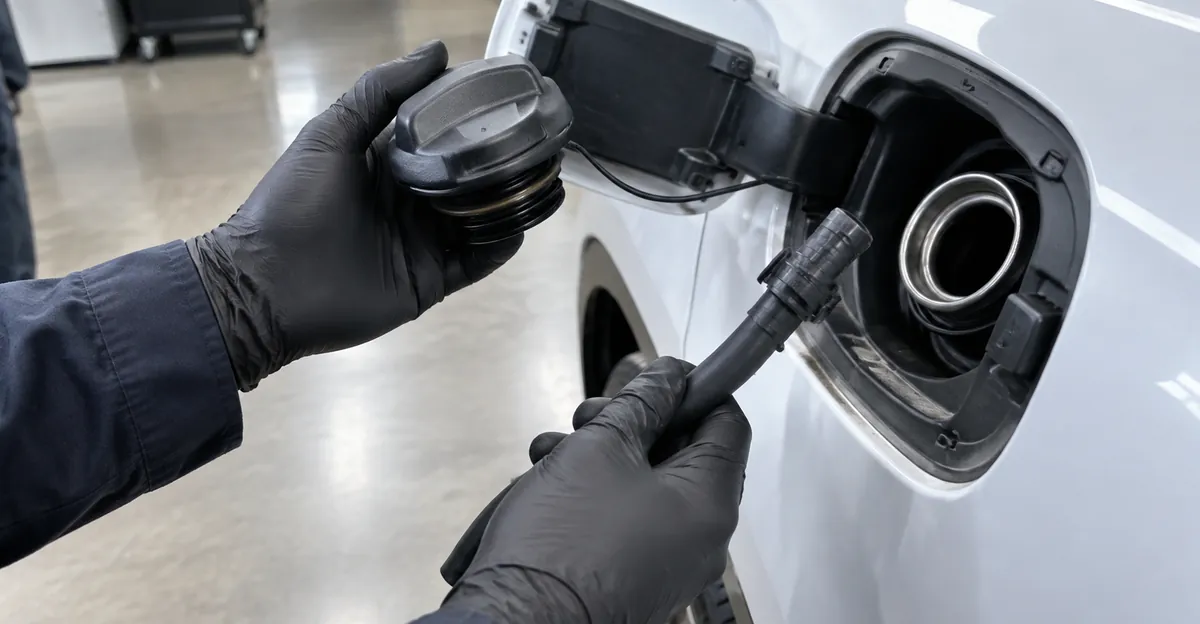
Click the cap until it clicks. Car-X says a loose, cracked, or missing cap lets vapor escape at the filler, and a check-engine light often comes on with it. CarParts.com describes diagnostic code P0457 as a large evaporative leak that the computer often ties to a cap that is loose, off, or no longer sealing. Dirt in the threads, a torn rubber gasket, or a cap that was left on the pump are enough. Some cars even have a separate cap warning. If the light and the odor showed up on the drive home from the station, the cap is the first part you touch, not the last.
Overfilling is the other station mistake. Topping off past the first click forces liquid fuel into the vapor hose and the charcoal canister. The canister is meant to hold vapor, not a cup of liquid. Once it is soaked, the car can smell like fuel for days, and the evaporative monitor may set a leak code because the system cannot pull down to the pressure it expects. Stop at the first click. If you already topped it off and the smell started that day, tell the shop. A soaked canister is a known pattern, not a mystery.
A cap that is tight, a light that stays on, and an odor that is still there the next morning is no longer a driveway fix. Car-X says the shop should then test the evaporative valves and hoses. A smoke machine pushes visible smoke into the vapor circuit and shows the exit. Guessing hoses in the parking lot usually means buying the same hose twice.
Under the Hood
Hood-up odor is closer to liquid than people want it to be. Fuel lines, the rail, and injector seals live next to the exhaust manifold. Car-X is direct: a leak there can start a fire, and you should not drive the car if you suspect one.
Look, do not touch a wet fitting with the engine running. A dark wet line, a rainbow sheen under the car, or a smell that spikes when you crack the throttle in park are reasons to shut it down. A cold engine that only smells for the first minute can be a seep that evaporates once the bay is hot. That still needs a pressure test. "It goes away" means the drip got smaller or burned off, not that the seal healed.
Exhaust leaks get blamed for a fuel smell because raw exhaust is unpleasant and people call every sharp odor "gas." Car-X separates them. An exhaust leak can hiss, sound louder, and push fumes toward the cabin. Those fumes include carbon monoxide, which you cannot smell reliably and which is dangerous in a closed car. If the note of the exhaust changed, or you hear a tick at the manifold, have the exhaust checked even if you also smell fuel. Do not idle in a garage to "see which smell it is."
A rich mixture belongs in this visit too, because the evidence is under the hood and at the tailpipe together. Poor mileage plus black smoke plus a fuel odor is the pattern Car-X ties to a regulator or a mixture fault. A scan for fuel-trim and pressure data comes before a new pump. Pumps are expensive. Caps and seals are not. Order follows the evidence.
The bay is also where a small seep hides under a plastic cover. Take the cover off only when the engine is cold and off. What you want is a dark stain at one fitting, a cracked nylon line, or a single injector that is wet at the base while the rest of the rail is dry. One wet injector is a seal. A wet rail end is a connection. Say which, if you can see it without leaning into a hot bay.
Rodents belong in the same look. Nylon vapor lines are easy to chew. A pinhole you cannot see still lets vapor out and can set an evaporative code without a puddle. Nesting, chewed plastic, or droppings on the cover are worth telling the shop. A smoke test finds that hole faster than a second cap.
When You Must Shut the Engine Off
Most odor complaints are not emergencies. These are.
- You can see liquid fuel, a drip, or a wet trail from the engine, the tank, or a line.
- The smell is strong inside the cabin and getting stronger while you drive.
- Anyone in the car feels dizzy, nauseated, or headachy. Get out, even if you think it is "just fumes."
- The exhaust note went louder or started hissing, and fumes are coming into the closed cabin.
- A fuel-system recall applies to your car and the odor showed up with it. Check the VIN on the manufacturer's recall page or through NHTSA before you assume it is only a cap.
For a faint odor at the filler, a cap you can click tight, and no liquid, you can drive to a shop. For anything on the list above, you tow. Car-X's rule on a suspected liquid leak is not to drive. Endurance says the same thing in different words: a strong, persistent smell in the cabin, pooling, or a fuel-leak recall is a now problem, not a next-oil-change problem.
If you already shut it off, do not restart it to move it "just off the driveway" if fuel is on the ground. Liquid fuel and a starter spark are a bad pair. Leave it, keep people back, and call for a tow.
What to Check Before You Keep Driving
These are observations. They are not a repair.
- Cap. Off, on, clicked. Look at the rubber ring. A cracked ring is done.
- Ground. Cardboard under the engine and the tank overnight tells you if it drips. A rainbow sheen is fuel or oil. Smell tells you which. Do not crawl under a hot car.
- Light. If a warning is on, read the code before you buy parts. P0457 points at a large evaporative leak and often the cap. A light with a tight cap still needs the evaporative test Car-X describes.
- Mileage and smoke. A sudden drop in mileage or black tailpipe smoke points at a rich mixture, not a loose cap.
- Place. Cabin-only, filler-only, or hood-only. Write it down and hand the shop that sentence.
Bring the sentence, not a theory. "It started at the pump, the cap clicks, the light is on, and I see no liquid" is a vapor visit. "There is a wet line on the rail and I shut it off" is a tow. "The cabin smells only on fresh air, and the exhaust got louder" is an exhaust-leak visit on top of a fuel check.
FAQ
Is a fuel smell right after filling up always a leak?
No. Vapor at the filler for a moment is normal. A smell that stays, especially with a check-engine light, is often the cap or liquid forced into the vapor canister because the tank was topped off. Click the cap. If the odor is still there the next day, the evaporative system needs a real test.
Can I keep driving if the cabin smells like fuel?
A faint odor and a cap you just tightened can go to a shop. A strong cabin smell, dizziness, or any visible fuel means stop. Car-X says not to drive a car you suspect is leaking fuel, because of fire. Carbon monoxide from an exhaust leak is a separate reason not to sit in the car with the engine running.
What if the check-engine light is on with the odor?
Read the code. P0457 is the large-leak code CarParts.com ties to a loose or missing cap, and a fuel smell can come with it. A tight cap plus a light means valves and hoses, not another cap from the parts counter. Do not clear the light to make the symptom "go away." The leak is still there.
Does a rich-running engine smell like raw fuel?
Yes. Car-X describes a failed pressure regulator dumping extra fuel so the engine runs rich, with poor mileage and sometimes black smoke. That odor can reach the cabin without a dripping hose. It is a fuel-pressure test. It is not fixed by driving faster.