
By Automotive Research TeamUpdated 2026-09-21
Car noises: match the sound to the moment
Car noises are a clue about timing, not a part name. A buzz in the dash, a tick under the floor, and a single click at the key are three different jobs. They can all sound "bad" through a closed window. They do not share a first check.
Write down the moment the sound starts and the moment it stops. Does it need the key in Start? The fan speed? The throttle? A turn? The brake pedal? Road speed, even if you lift off? That sentence is what you tell a shop. "It makes a noise" is not.
De Re Tire & Auto puts the same test in shop language. A sound that rises and falls with wheel speed, and ignores what the engine is doing, lives at a corner: a bearing, a tire, sometimes a brake. A sound that appears only with the wheel turned lives in a joint or in the steering. A sound that needs the pedal, a bump, or the throttle is a third family. Ford's noise, vibration, and harshness tables for the Freestyle do the same split, one row at a time: cruise versus coast, turn versus straight, cold versus hot, blower on versus blower off.
Use the table before you buy a part. It is a sort, not a quote.
| When it happens | Likely cause | First check |
|---|---|---|
| Key on, engine off, pitch follows the fan knob | Blower motor | Change fan speed. If the pitch changes, stop looking at the alternator |
| Cruise and coast, same buzz, no throttle effect | Tire | Look at cupping and feathered tread before a hub |
| Under the hood, changes when you switch on lights or the rear defroster | Alternator | Battery light, then a charging-voltage test |
| Bottom of the car, follows rpm in Park, or a bump | Heat shield or hanger | Look under the car. Do not rev it in a closed garage |
| Cold upper engine, worse before warmup | Oil level or valvetrain | Dipstick on level ground, engine off |
| Rapid clicks, no crank | Battery or cables, sometimes the alternator behind them | Lights, terminals, then a jump. Not on a swollen case |
| One click, lights stay bright, jump does not crank it | Starter | Stop holding the key. Tow it |
| Tight turn, rhythmic click, quiet when straight | Outer joint on a drive axle | Boot, grease spray, which direction |
| Speed hum that changes in a lane change | Wheel bearing | Which way it gets louder. Play at 12 and 6 on a lift |
| Pedal down only | Brake pad, rotor, or hardware | Pedal feel. Grind means stop driving |
| Vents, only with cold air requested, cooling is weak | Refrigerant leak | Leak check. A top-off is not the repair |
| Hood open, hiss at idle, air conditioning off | Vacuum leak, or a normal plastic manifold | Do not confuse it with the vent hiss |
Nothing in that table replaces a measurement on your car. Voltage, pad thickness, and hub play are shop tests. The table only stops the wrong test from being the first one.
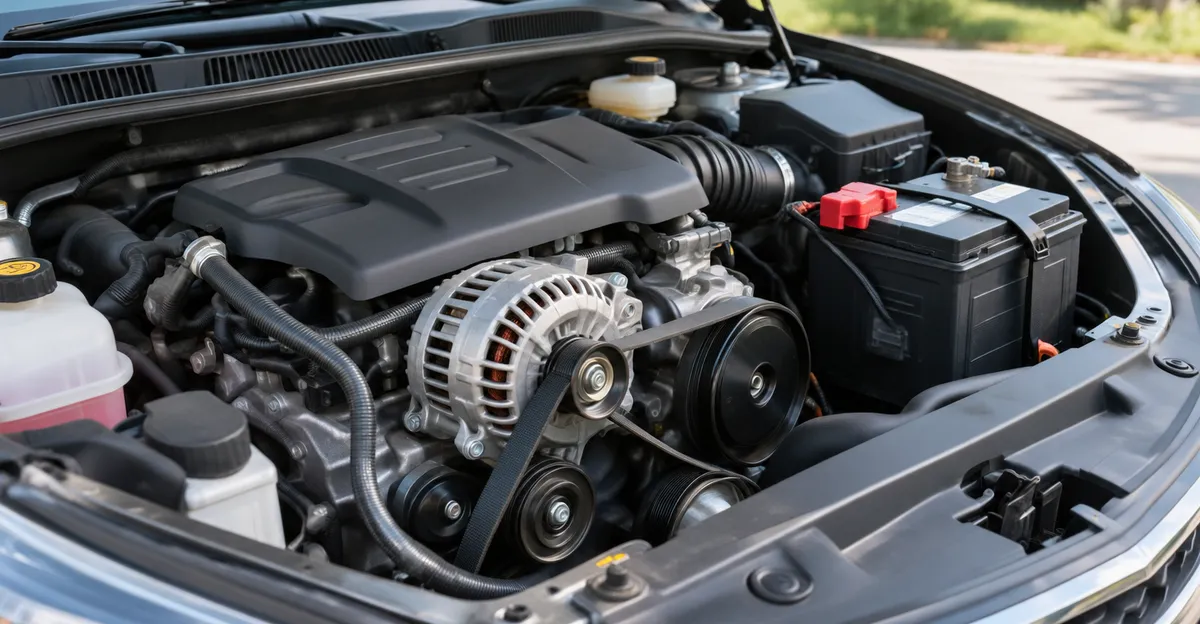
Car making buzzing noise
A buzz is a fast, even vibration. It is not a tick, and it is not a click you can count. The useful split is whether the engine has to be running.
Key on, engine off, and the sound lives in the cabin. Turn the fan knob. Ford's idle-noise table says to listen for a change in pitch or loudness as blower speed changes. If the sound moves with the knob, the row points at a worn heating and air-conditioning blower bearing, and the listed action is a new blower motor. That is a cabin part. An alternator cannot buzz with the engine stopped. People still replace one, because the sound is electrical and the alternator is the electrical part they can name.
Engine running, and the buzz is the same on the throttle and off it, at the same road speed. Ford's driveline table calls a buzz that is the same at cruise and on coast a tire problem, and the action is to check for abnormal wear. A cupped or feathered tire hums. De Re says a technician looks at tread pattern and inflation before condemning a hub, because a new hub does nothing for a bad tire. If the buzz dies the instant you lift off, and it does not care about road speed, it is not that row.
Under the hood, and the note changes when you add electrical load. Switch the headlamps on. Switch the rear window defroster on. Ford's generator row is a high-pitched whine or moan under high electrical load at idle. The test is a charging-system load test. If the generator passes and the noise is still there, Ford says the noise is the bearings. If it fails, Ford says install a generator. AAA describes the same part from the driver's seat: a grinding or whining noise from under the hood while the engine runs, often with a battery-shaped warning light, dim lamps, or a battery that dies again after it was just replaced.
AAA also gives the numbers a meter should show, and says to have a shop do the test if you are not sure. Engine off, a healthy battery reads around 12.6 volts. Running, the reading should sit between 13.8 and 14.2 volts. Below 13 volts with the headlamps or the air conditioning on, or a spike above 15 volts, and AAA says the alternator needs attention. Those are test values, not a guess from the pitch of the buzz.
A buzz you feel in the pedal at idle can be a loose or misrouted throttle cable. Ford lists that separately from a noise in the air. A high-frequency idle vibration through the wheel or the seat, in the range Ford calls 20 to 80 Hz, is filed under exhaust mounts that are bound up, or loose body mounts, or power-steering lines touching the chassis. A low-frequency shake, 5 to 20 Hz, is filed under a misfire. Same seat. Different row. If the engine note is uneven, read the misfire row before you buy a belt.
Do not spray the belt with anything to "see if the buzz goes away." A dressing hides a glazed belt for a few minutes and contaminates the pulley. If the belt is frayed, cracked, or the tensioner is bouncing, that is a visual check with the engine off. Ford's accessory-drive row treats a chirp at idle in humid weather as a worn belt or a pulley that is loose or out of line.
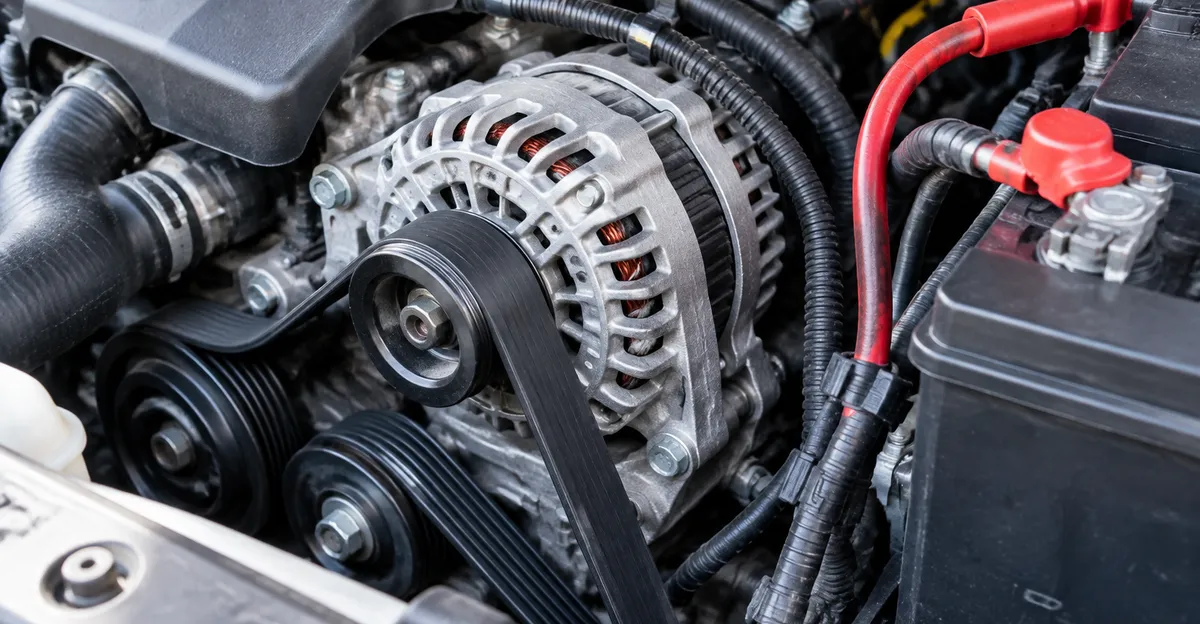
Car making rattling noise
A rattle is loose metal hitting metal. It starts and stops with vibration. It is not a hum that holds a note.
Ford splits rattles by where they seem to live. A rattle from the bottom of the vehicle is loose muffler shields or catalytic-converter shields. The action is to check those shields and repair them. A separate idle row says an intermittent rattle, or a scrape, can be a loose exhaust heat shield, confirmed with a gloved hand or a clamp on the shield while the system is cold enough to touch. A thump from the bottom that gets worse on acceleration can be an exhaust pipe or muffler grounded against the chassis, or a hanger that has torn. Those are exhaust parts. They are not a wheel bearing, even when the sound seems to come from one corner. Sound travels through the floor.
The driveway test is the one De Re uses. Put the car in Park. Raise engine speed with your foot. If the rattle appears and fades with rpm while the wheels are not turning, it is not a bearing and it is not a joint. De Re names a loose exhaust pipe or a corroded heat shield for that pattern, and a roar under acceleration for a leak or a crack. A small leak can tick. A shield rattles. Do not stand under the car while someone revs it. Do not idle in a closed garage to "hear it better." Exhaust gas does not care that you are only listening.
A rattle over bumps, quiet on smooth pavement, is a different row. De Re treats a single metallic knock on a bridge joint as a suspension noise, often a sway-bar link, and warns that the side you hear is not reliably the side that failed. Ford's squeak-and-rattle table also lists worn control-arm bushings and worn struts for noise over bumps or in a turn. A shield can rattle on a bump too, because the exhaust moves. The Park test separates them. Bump only, silent in Park at higher rpm: suspension or a hanger. Present in Park: exhaust or the engine.
Cold upper-engine rattle is oil until the dipstick says otherwise. Ford's table says a valve-train rattle that is worse cold can be low oil, thin or diluted oil, low oil pressure, or worn rockers, guides, or seats. Check the level on level ground with the engine off, the way the filler cap describes. If the level is low, that is the first fact. If the level is right and the rattle stays after warmup, it is not "just cold oil" anymore. A continuous speed-dependent rattle on a cold start that disappears as the engine warms is filed by Ford as piston or valvetrain noise. That is a shop measurement, not a thicker oil poured in as a cure.
AAA adds one rattle you should not keep cranking through. In the list of reasons a car will not start, a ticking or rattling noise from the engine while you try to start is one of the signs of a worn timing belt. AAA says timing belts typically need replacement every 60,000 to 100,000 miles, and says to stop turning the key if you suspect the belt, because repeated cranking can damage the engine. A rattle at idle with the engine already running is not that warning. A rattle instead of cranking is.
A loose caliper bolt can rattle too. Ford's brake table lists a rattle from loose caliper mounting bolts, with the action to check and tighten them to specification. That rattle is at the wheel, often with a change in pedal feel. It is not a license to torque a caliper by feel in a parking lot. Specification means a torque wrench and the service data for that bolt.
Car making clicking noise
A click you can count is not a buzz. On the road, a rhythmic click in a turn is a joint. At the key, a click with no crank is electrical. Mix those two and you buy an axle for a battery, or a battery for a torn boot.
Ford's driveline table is blunt about the moving click. Clicking, popping, or grinding while the vehicle is turning can be a joint that has lost clean grease. The same table also lists a halfshaft touching something, brake parts, steering linkage, ball joints, and wheel bearings. Clicking or snapping while accelerating around a corner narrows it: damaged or worn outboard joint, and the action is to inspect that joint and its boot. De Re describes the driver's version. The click shows up in a tight, slow turn, often into a parking space, and it stops when the wheel is straight. A clunk as you get on and off the throttle points at the inner joint instead. A torn boot is the usual reason. Grease leaves. Grit and water enter. A boot torn in winter can be a clicking joint by summer. Look for a spray of grease on the inner fender or the suspension arm. A boot that is whole and full is not a reason to ignore the click. It is a reason to let the shop load the joint on a road test before an axle is sold.
De Re's confirmation is specific. For an outer joint, the car is driven backward in a circle with the steering at full lock. For an inner joint, reverse with the throttle on and off. You do not need to do that in a crowded lot. You do need to tell the shop which direction is louder, and whether a straight road is quiet.
A click at the key is the next two headings. It is not this one.
Clicking noise when trying to start car
A clicking noise when starting car is the same moment, and the number of clicks is the split. Les Schwab separates a single click from a rapid series. AAA files both a click and plain silence under a battery that is dead or dying, and then gives the starter its own row.
Read the lights before you read the sound. Dim lamps, a radio that cuts out, crust on a terminal, or a battery older than AAA's 3-to-5-year window all sit on the battery row. A rotten-egg smell, or a case that has swollen, sits there too, with a hard stop: AAA says do not jump a swollen battery, because it can burst and throw acid. Call for a tow.
Les Schwab puts a number on ordinary age. The average battery lasts three years, according to AAA, and heat, climate, and how you drive move that. A battery that is merely old can still click. Age is a reason to test it. Age is not, by itself, a receipt.
Terminals are the check you can see. Les Schwab describes corrosion as a flaky white growth on the posts. Loose or corroded clamps can click, dim the lamps, and stall the car later, because the starter never gets the current the case still holds. The cleaning mix Les Schwab gives is one part baking soda to three parts water, with a stiff brush. Wear glasses and gloves. Take off metal jewelry. Confirm the red cable is on the positive post and the black cable is on the negative before you tighten anything. Set the parking brake and leave the transmission in Park. Les Schwab's first step is Park rather than Neutral, because Neutral can roll.
A rapid series of clicks means the solenoid is pulling in and dropping out. Les Schwab says the battery is too weak, or the alternator has left it that way, or the electrical system is dropping voltage. AAA's meter values from the buzz section are the follow-up after it starts, not a reason to keep the key in Start. If a jump gets it running and it dies when the cables come off, Les Schwab says the alternator is the likely reason. If it stays running, test the battery before you call it fixed. A discharged battery and a failed battery feel the same at the key.
Electric vehicles do not follow the click rule. Les Schwab notes that a dead 12-volt battery in an EV can leave the car silent, with no clicks, and can lock functions. Jump that battery only the way the maker describes.
Car won't start clicking noise
A car makes clicking noise when trying to start, the lamps stay bright, and a jump does not produce a crank. That pattern is the starter row.
AAA's signs are a slow crank before the failure, lamps that come on, and then a single click or nothing while those lamps stay on. The listed action is a shop. A starter is not a parking-lot part on most cars. Les Schwab agrees on the split: one click, and a jump that does not fix it, points at the starter. Most starters last more than 100,000 miles, and the miles move with how often the engine is started. Les Schwab also says to try the key or the button more than once before a tow, and to try a hidden key slot if the car has a button and a backup reader. That is a retry, not a half hour of holding Start. Holding Start on a solenoid that only clicks heats the circuit.
Ford's cranking table is the mechanical cousin. A grind during cranking can be a starter mounted wrong, a bad starter, or a drive that is not engaging the flexplate. A grind is not a click. If the engine locks and the starter smashes into the ring gear, stop. More key cycles are how a starter repair becomes an engine repair.
AAA's ground-cable row sits beside this. A loose or crusted ground can flicker the lamps and leave the engine struggling to turn. Look at the cable end on the engine or the body, not only the battery post. AAA also lists a blown fuse, an ignition switch, a steering lock, a key-fob battery on a push-button car, and a neutral-safety switch. Those can be silence rather than a click. If the shifter indicator and the lever disagree, try a firm Park, then Neutral, with the brake held. If Neutral starts it and Park does not, say that. It is a switch story, not a starter story.
The battery is still the first part to prove, because a weak battery mimics a starter and a starter mimics a weak battery. Prove it with a jump or a load test. Then buy the other part.
Car makes noise when turning
A car making noise when turning has already given you the trigger. Straight is quiet. Turned is not. The remaining question is click, grind, or squeal, and whether speed or the throttle joins in.
De Re's rule is the one to keep. Rhythmic clicking or popping in a turn is an outer joint. Squeaking in a turn, without that click, points at the steering system: low power-steering fluid, a pump, or the rack. They are different repairs. Ford's steering table adds a hiss from the gear that can be a binding intermediate shaft, a grounded column boot, or a worn input valve. A hiss at the column is not an axle. A click at full lock in a parking lot is not a fluid top-off.
Power-steering whine has its own rows, and they are easy to misfile as "noise when I turn" because the pump works hardest at low speed with the wheel off center. Ford lists a pump whine as aerated fluid, with the action to check for a leak and purge the air, and also as a damaged cam or a valve-cover O-ring. A moan on the first cold start, around 0°F (−18°C), can be thick fluid or a plugged reservoir screen starving the pump. Ford says that moan can become a severe screech for less than a minute in cold around −20°F (−29°C). A screech that lasts one cold minute and then goes away is not the same complaint as a whine every time you park. A belt that squeals only while the wheel goes from stop to stop is Ford's loose or worn accessory belt, not a joint.
A groan at parking-lot speed can also be a strut mount. Do not spend the axle money until someone has loaded the joint and looked at the boot. Tell the shop the direction, the speed, and whether the throttle changes it.
Car makes grinding noise when turning
A grind in a turn is harsher than a click. Ford files clicking, popping, or grinding while turning under joints that lack clean grease, and also under brakes, steering, suspension, and bearings. UTI describes grinding, humming, or growling from a failing wheel bearing when you turn or when speed rises. De Re separates them by rhythm. A click that counts with the turn is the joint. A growl that holds and changes as weight shifts in a lane change is the bearing. A grind that appears only while the pedal is down is the brake section, even if you happen to be turning when you notice it.
The wheels are where this gets confirmed. De Re rocks the wheel at the 12 o'clock and 6 o'clock positions on a lift. Any play suggests the bearing. On most newer cars the bearing is part of the hub, so the hub is replaced as a unit. Play is a measurement. A guess from the driver's seat about which corner is loud is only a hint. De Re says the side you hear is not reliable for suspension knocks, and the same caution applies here. A road test that reproduces your turn is the location. The lift is the name.
UTI's warning is the reason not to wait on a growing grind: a failed bearing can lead to uneven tire wear, loose steering, and, in the extreme, a wheel coming off. A faint hum with no play can be driven in. A grind with play, a pull, or heat at the wheel after a short drive should be towed. Heat at one wheel, with the others cool, is friction. It is not "the brakes, probably."
Whining noise when car accelerates
A whine that shows up as you ask for power, and fades when you lift, is load. It is not the tire buzz that stays the same on coast. Ford's engine table files a whine or moan under the air intake, or under the generator's electrical field or bearings. A drone at steady speed is more often the exhaust or the air-conditioning compressor. Cycle the compressor. If the pitch changes only when the clutch clicks on, Ford points at the compressor, not the transmission you were about to blame.
The generator test is the clean one. Add load: defroster, lamps. If the whine grows at idle with those loads, use the load test from the buzz section. Passing the test with the noise still present means bearings. Failing it means the generator is not charging, and AAA's voltage window is how you show that. A whine only while the wheel is turned is the power-steering pump row above, including air in the fluid. Look for a wet line at the reservoir before you assume the pump is ruined. Ford also calls some pump noise acceptable: a swish of fluid through the bypass when the fluid is below 130°F (54°C). Acceptable means it is on the chart as normal. It does not mean every new whine is normal. A whine that started this month is not "just the pump being a pump" until someone has checked the level and the load.
Acceleration also loads the inner joint. De Re says a bad inner joint clunks as power goes on and off, and can shudder. A clunk is not a whine. If you have both, say both. Shops replace the noisy part you named and leave the one you folded into "and it also does this."
A whine from the intake is often a split hose or a loose duct. Ford says to check the air cleaner and the ducts for fit and leaks. A missing clamp after a filter change is a common version. You can see a duct that is off. You cannot hear a bearing and call it a duct.
Car making humming noise
A hum that tracks road speed is the bearing complaint people describe as a drone. UTI lists humming, growling, and grinding when you turn or speed up, plus a faint vibration in the wheel or the floor at higher speed, a pull, loose steering, and heat at the wheel. De Re says the classic version is quiet around town and obvious on the highway, then different in a lane change, because the bad bearing takes more load on the outside of the turn. Tires hum too. That is why tread comes before a hub.
Ford's tire-buzz row and this hum meet in the middle. If the sound is identical on the throttle and off it, start with the tires. If it changes when you change lanes and the tires look even, the bearing moves up. If it changes with engine rpm in Park, leave the wheel chapter. You are back at the exhaust or the engine.
Do not "live with it for the season" once it is a roar. De Re's stop list is a hum that has become a roar, especially with play, vibration, or wandering. UTI's end point is a wheel leaving the car. The in-between, a steady hum and a car that still tracks, is a soon appointment, not an emergency tow. Say which speed it starts, and which way the lane change makes it louder.
Car makes noise when braking
If the sound needs your foot on the pedal, it is a brake noise. De Re calls that the cleanest correlation in a noise visit. The brakes are the system. A click in a turn is not this section. A hum at 60 mph with your foot off the pedal is not this section.
AAA's Via guide, quoting a AAA-approved shop owner, separates a harmless squeak from a grind. Moisture on the pads and rotors can squeak, especially in the morning, and then go quiet. Pads also carry a metal wear indicator that squeaks as the friction material gets thin. That squeak is the warning working. A grind means the friction material is gone and the metal backing is on the rotor. AAA calls that serious. De Re says the same thing in shop language: squeal is the indicator, grind is metal on metal, and a sticking caliper can grind too. A rattle with a pulsing pedal can be a rotor that is no longer flat, or hardware that is missing.
AAA gives mileage as a range, not a promise. Pads can last 30,000 to 80,000 miles depending on how you drive. Rotors are intended to last at least 30,000 miles, and can be done in 20,000 miles if you brake hard in hills every day. The inspection interval in that article is at least every six months, or at an oil change if you drive hard. A squeak at 40,000 miles is not "too soon to be pads." A quiet car at 70,000 miles is not proof the pads are fine.
AAA's published averages in that piece: pad replacement on the order of $100 to $300 per axle for standard brakes, and a complete job with pads, rotors, and calipers close to $1,000. Electronic parking-brake systems cost more because the shop needs the software. Those are averages from one approved shop's account, not a quote for your car. The point of catching the squeak is that the grind spends the rotor.
Drive or stop. De Re says a wear-indicator squeal with normal pedal feel and normal stopping can be driven gently to the shop. Grinding cannot. AAA's shop owner, Bruce Vuong, says if the pedal only travels about three quarters of the way, come in immediately, and do not drive a car with weak brakes. A soft pedal, a pull, a burning smell, or a warning lamp belongs on a tow truck. Leaking fluid is a hose or a line until proven otherwise. If the brakes are smoking after a long downhill, pull over and let them cool. Vuong says not to pour water on them. The shock can warp the metal.
A morning squeak that is gone after a few stops is the moisture row. A squeak that is there every stop, all day, is the indicator row. A grind is the stop-driving row. Write which one you have. "The brakes are noisy" gets you a guess.
Hissing noise from car ac
A hiss from the vents, only when you ask for cold air, with air that is no longer cold, is a low refrigerant system until a leak check says otherwise. It is not the under-hood hiss Ford lists at idle.
Ford's idle table describes a hiss with the hood open, at idle or high idle. The sources are a vacuum leak or idle-air flow, found with a leak detector along the intake, or, on some cars, a plastic intake manifold that hisses as a normal trait. That hiss does not care whether you pressed the snowflake button. If the hiss is there in Park with the air conditioning off, use that row. Split hoses and loose clamps are visible. A plastic manifold that has always hissed is not a new leak.
The vent hiss is the other row. Cooling that faded over weeks, a hiss at the dash when the compressor is commanded, and oily residue at a line fitting are the pattern. The U.S. EPA's guidance on recharging a motor-vehicle air conditioner is the constraint on the fix. Owners have three options: top off, evacuate and recharge, or repair the leaking part and then recharge. EPA says a top-off or a recharge can improve cooling and still not fix the leak. Repairing or replacing the leaking component lasts longer if it is done properly.
A top-off is a guess. EPA says the technician cannot know how much refrigerant is already in the system, so the amount added can be low or high, and either one hurts performance. Evacuation lets the shop put back the amount the manufacturer specifies, and recycle what comes out. Some shops say federal rules forbid returning your refrigerant to the car. EPA says no such rule exists. What does exist is a leak check. Technicians find most leaks with an electronic detector certified to SAE J1627, and they can miss a very small one. A full charge is not required to look. EPA says a few ounces, about 10 percent of a normal charge, can be enough, and sometimes refrigerant has to be added before a small leak will show.
EPA does not require the leak to be repaired before a system is charged. Some states and cities do. Ask before you pay for a can. Adding refrigerant without finding the leak buys cold air until the new charge leaves. It also risks an overcharge. Do not vent the system to "let it hiss out." Do not mix products. The label under the hood names the refrigerant. A can from a parts store that does not match that label is the wrong experiment.
A hiss with warm air and a clutch that never engages can be a switch or a low-pressure cutoff doing its job, because the system is empty. That is still a leak check, not a blower motor. The blower test from the buzz section still applies if the sound changes with the fan knob and the engine is off.
What to check before you keep driving
Bring five facts, not a part name. De Re asks for the speed where it starts, whether a turn is required and which way, whether the pedal or a bump is required, your best guess of the corner, and whether it changes with rpm in Park. Add how long it has been happening. A noise that started the day a belt was installed is a different visit from a noise that grew for a year.
Then do only the checks that do not require a lift.
- Fan knob, engine off. Pitch changes: blower. Pitch does not change: leave the blower alone.
- Park, foot on the brake, raise rpm. Sound follows rpm: exhaust, intake, or engine. Sound stays gone: it needs road speed or a turn.
- Dipstick, engine off, level ground, if the rattle is in the engine bay and worse cold.
- Battery posts, if the complaint is a click and no crank. White crust, loose clamps, a swollen case. Do not jump a swollen case. AAA is explicit.
- Pedal. One firm stop in an empty lot. Squeak only, pedal normal: you can drive it in. Grind, pull, or a pedal that sinks: stop.
Say the result in one line. "Rapid clicks, lamps dim, crust on the positive post." "Hum from 45 mph up, louder in a right lane change, quiet in Park." "Grind only with the pedal, started as a squeak last month." That line is the diagnosis you can actually support. The part name comes after the lift.
Stop and arrange a tow, do not "see if it gets worse," when any of these are true:
- One wheel is hot, the car pulls, or the steering wanders with a hum or a grind.
- The brake pedal is soft, the car pulls under braking, you smell burning, or you hear grinding.
- The battery case is swollen, or you smell sulfur at the battery.
- A rattle has replaced cranking and you are past the timing-belt interval AAA cites.
- A jump starts the car and it dies as soon as the cables come off, and you are not somewhere you can test the charging system today. Limping it across town is how a dead battery becomes a tow in a worse place.
A steady hum, a turn click that has not spread to straight driving, a brake squeak with a normal pedal, and a shield rattle with no change in handling can be driven gently to the shop. De Re's list matches that. Gently means you are not gathering more data at highway speed to be sure. You already have the sentence.
FAQ
why is my car making a rattling noise
Because something metal is loose, and the moment tells you which metal. A rattle that follows rpm in Park is a shield, a hanger, or the engine. Ford points the underbody version at muffler shields and converter shields, and the cold upper-engine version at oil level or the valvetrain. A rattle only over bumps is a hanger or a suspension link, and the side you hear can be wrong. A rattle instead of a crank, on a belt that is due, is a reason to stop turning the key.
What does one click mean if the dash lights stay bright?
AAA treats that single click, lights still on, as a starter-shaped failure. Les Schwab wants the jump first, because a battery that still lights the dash can still fail under starter load. If the jump cranks the engine, test the battery and the cables before you buy a starter. If the jump does not crank it, the starter is the next test, on a truck, not in the driveway. A swollen case skips the jump.
Can I drive with a hum that gets louder with speed?
A steady hum, car tracking straight, no play you already know about: drive it in soon. De Re allows that. A roar, a pull, or play at the wheel: do not. UTI includes a wheel coming off among the ways a bearing failure ends. Heat at one wheel after a short trip belongs in the second group.
Does adding refrigerant stop a hiss and weak cold air?
It can restore cold air without closing the leak. EPA says so directly: topping off and recharging are not permanent repairs. Fixing the leaking part is the option that lasts. The amount in a top-off is a guess. A leak detector that meets SAE J1627 is the test, and EPA says about 10 percent of a normal charge can be enough refrigerant to run it. Some states require the repair before a recharge. A can that does not match the under-hood label is not a shortcut.