
By Automotive Research TeamUpdated 2026-09-20
Car Shakes When Braking: What the Shake Is Telling You
A car shakes when braking because the brake disc is no longer the same thickness all the way around, a caliper is hanging on, or something else in the wheel is only obvious once the pads clamp down. The shake is a clue about timing, not a part name. This guide sorts that clue: pedal-only shake, throttle-only shake, a shake that tracks road speed, a shake at a stop, a shake that showed up the morning after snow, and a shake with a flashing engine light.
You should leave with a short list of what to tell a shop, and a shorter list of reasons to stop driving. Nothing here replaces a measurement on your car. Rotor runout, misfire counts, and wheel balance are shop tests, not guesses from the driver's seat.
Why Is My Car Shaking
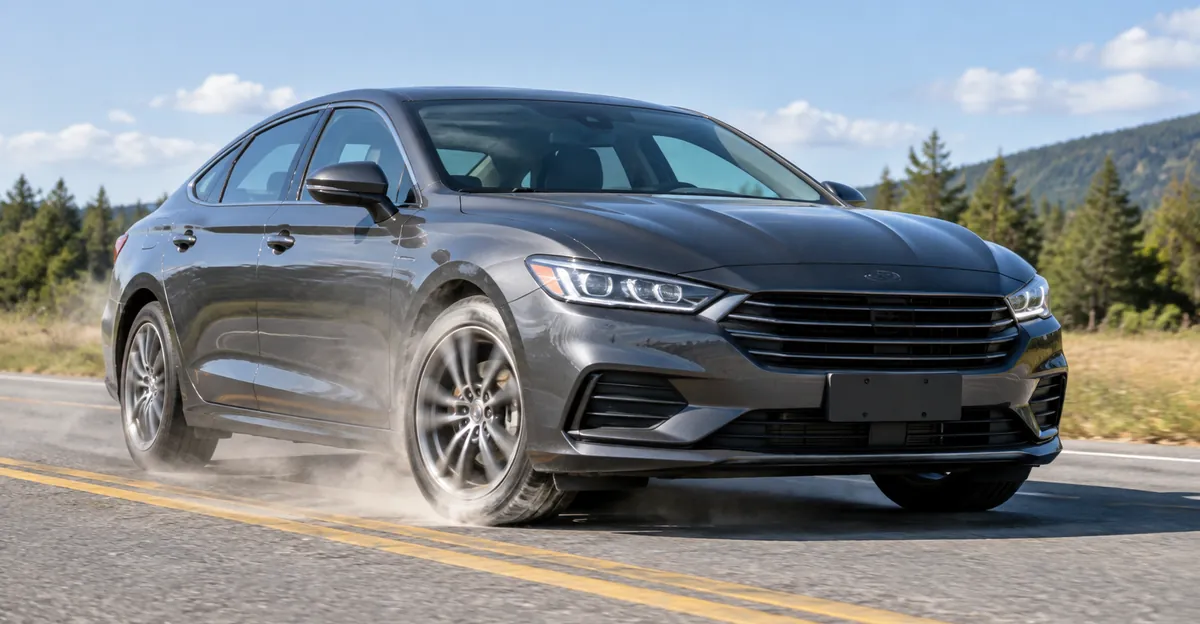
If the search in your head is why is my car shaking, or the shorter why does my car shake, ignore the parts catalog for a minute. Write down the moment the shake starts and the moment it stops. A brake problem, a tire problem, and an engine problem can all feel like the same buzz in the seat. They do not show up at the same time.
Use one drive, on a quiet road, and answer four questions.
- Does it happen only while your foot is on the brake, and disappear as soon as you lift?
- Does it happen when you press the accelerator, and fade when you coast?
- Does it show up at one road speed no matter what your feet are doing?
- Does it happen while you are sitting still, then calm down once the car is moving?
That split is the whole diagnosis. AAA treats vibration through the brake pedal as a rotor problem, and highway steering shake that eases when you slow down as a balance problem. Those are different jobs. A shop that "does the brakes" because you said the car shakes will miss a tire. A tire shop will miss a caliper that only grabs while you stop.
Where you feel it matters as a note, not as a verdict. Pedal pulsation points at the brakes. Steering-wheel shake at a steady highway speed points at the front wheels. A shake in the seat can be a rear wheel, a driveshaft, or the engine, depending on whether the car is moving. Tell the shop the location. Do not let the location pick the invoice by itself.
A manufacturer brake bulletin archived by NHTSA makes the same point from the service side. Brake vibration can depend on speed, pedal pressure, and how hot the brakes are. The bulletin tells technicians to road-test under the same conditions the driver actually uses. If your shake only happens on a highway exit, a parking-lot test will come back clean and you will be sent home with the same car.
| When the shake shows up | What it usually means | First check |
|---|---|---|
| Only while the brake pedal is down | Uneven rotor thickness, a sticking caliper, or a suspension or tire fault that braking uncovers | Brakes, then tires if the brakes measure true |
| Only while you accelerate | A joint, mount, or misfire that appears under load | Engine scan, then axles and mounts |
| At one road speed, throttle or not | Wheel balance, a damaged tire, or tread cupped by alignment | Wheels |
| At a stop, smoother once you move | Engine mounts, or a misfire that is worst at idle | Compare Neutral and Drive, then scan |
| The morning after snow, mostly on the highway | Ice packed in a wheel | Clear the wheels before you buy parts |
| With a flashing engine light | A misfire severe enough to damage the catalyst | Stop. See warning lights |
Two traps waste money. The first is replacing rotors because the car shakes at 60 mph with your foot off the brake. The second is balancing tires because the steering wheel pulses only while you stop. Match the test to the moment.
Why Does My Car Shake When I Brake
The question why does my car shake when i brake is narrower than a general vibration. The shake arrives with the pedal and leaves when you release it. Drivers who say my car shakes when i brake usually feel it in the steering wheel, the pedal, or both. A car shakes while braking for a mechanical reason in that clamp, not because the engine "needs a tune-up."
AAA's brake guide is blunt about the driver's version of this: vibration on the pedal when you apply the brakes indicates warped brake rotors, and a shop should decide whether to resurface or replace them. AAA Club Alliance says the same thing in driver language. Heat from repeated stops can distort rotors, the steering wheel shakes when you brake, and you should have the car serviced soon. They also say you can keep driving a short while, but the shake beats up suspension parts and tires if you ignore it.
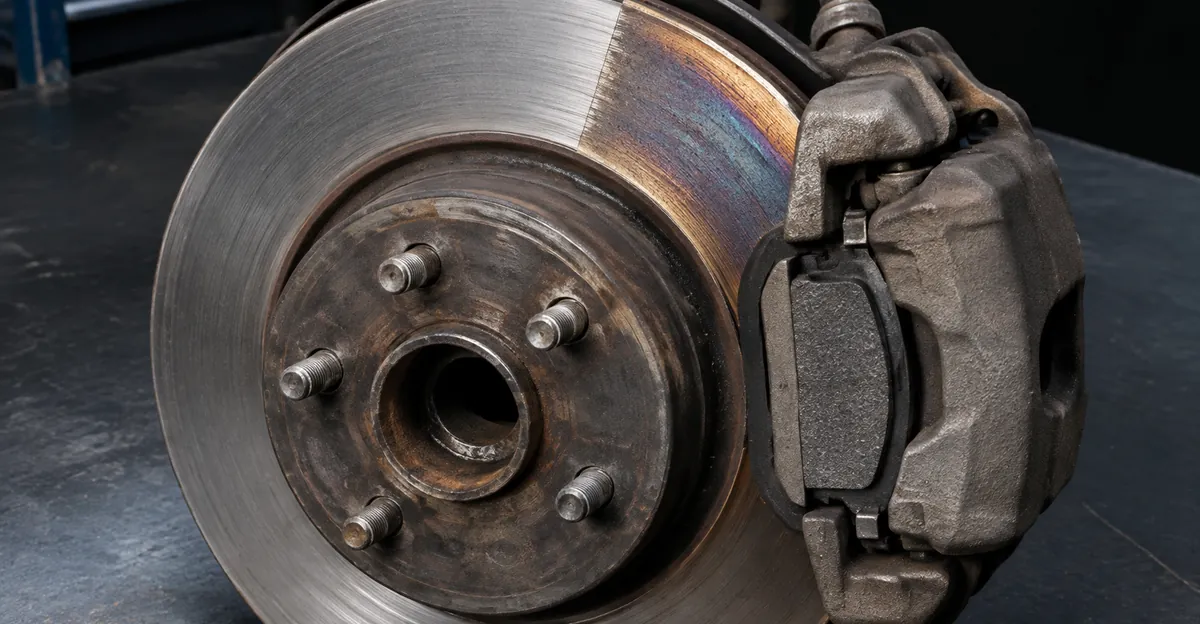
Technicians often refuse the word "warped." Rick Muscoplat, writing for a repair-advice site, argues that ordinary street driving rarely gets a cast-iron rotor hot enough to bend it. What you feel is disc thickness variation. The rotor is thicker in some spots than others, so the pads grab and release once per revolution. He traces that thickness change to lateral runout: the rotor is not sitting flat on the hub, so it wobbles, the pad kisses one side harder, and deposits or wear build up. He cites a common carmaker limit of about 0.003 inch of runout, and says he has measured that little movement producing a shake you can feel. He also says new rotors on a dirty hub often bring the pulsation back in roughly 2,000 to 3,000 miles.
A service bulletin on NHTSA's site agrees that "warped" is too small a word, without using Muscoplat's numbers. It lists several ways a car can pulsate under the pedal:
- Pad material smeared onto the disc after hard stops with no time to cool. The fix in that bulletin is new discs and pads, not a fluid flush.
- Too much runout in the disc or the hub, including wheels tightened with an impact gun or torque sticks instead of a torque wrench. The disc and hub distort.
- Worn suspension parts, such as ball joints, links, tie rods, and bushings, that amplify a small vibration until you only notice it while braking.
- A wheel or tire that is out of balance, or a tire with radial runout, doing the same thing.
So the honest answer to a brake shake is "measure the rotors and the hub," not "you need rotors" and not "rotors never cause this." AAA is describing what the driver feels. The bulletin and the repair write-up are describing what the dial indicator finds. Both can be true on the same car.
A sticking caliper is the other brake part that deserves a name. AAA Club Alliance describes a caliper that stays clamped after you lift your foot, or that grabs suddenly. Dirt and failed slide pins do that. The wheel gets hot, the car may pull, and the pad can glaze or transfer material onto one face of the rotor. That is not a "drive it until the next oil change" problem. A stuck caliper is a stopping problem.
Pads belong in the same visit. AAA says a high-pitched squeal or a grind means the wear indicator, or the pad backing, is meeting the rotor. They suggest looking through the spokes: pad material thinner than about 1/4 inch is due for replacement, and a rotor with cracks or deep grooves is not a candidate for "just live with it." A shake plus a grind is pads and rotors together, not a mystery vibration. AAA's published range for pads and rotors is about $250 to $500 per axle, or about $500 to $1,000 for the whole car. That is a national average for the job, not a quote for your car, and it assumes the hub is true. If the hub is bent, the same invoice comes back.
What to say at the counter, if the shake is only there while you brake:
- It happens when I slow down, and it stops when I lift off the pedal.
- I feel it in the pedal, the steering wheel, or the seat. Say which.
- It showed up after a brake job, a flat repair, or a pothole, if that is true.
- Please measure rotor thickness variation and hub runout, and check that the lug nuts were torqued to spec. Do not only "resurface and send it."
Skip the brakes-first visit if the shake is there at a steady speed with your foot off the pedal. That is the next sections, not this one.
Car Shakes When Accelerating
A car shakes when accelerating when the vibration tracks the throttle. You tip in, the car shudders, you lift, and it smooths out. That is not a rotor. Rotors announce themselves when you slow down. This one announces itself when the engine or the axle is asked to push.
Why Does My Car Shake When I Accelerate
why does my car shake when i accelerate is the load question. Hold a steady speed, then accelerate in the same gear. If the shake appears only while the engine is working, you are sorting three families: a misfire under load, a mount that lets the engine rock, and a joint that only complains when it is twisting.
A misfire is an engine that is not firing every cylinder on time. Identifix's guide to P0300 describes the driver's side of that: rough idle, hesitation or jerking under power, a flashing or steady check-engine light, a fuel smell, and poor acceleration. The code means the computer saw misfires it could not pin on one cylinder, and a cylinder-specific code from P0301 through P0308 often sits next to it. Causes on that list include coils, plugs, injectors, fuel delivery, vacuum leaks, and sensors. The point for you is narrower. If the shake comes with a stumble and a light, start with a scan. Do not start with motor mounts.
A Volkswagen misfire bulletin on NHTSA's site is useful even if you do not drive a Volkswagen, because it states a rule shops violate. A random P0300 is not a reason to replace every coil, plug, and injector. Look for a cylinder-specific code, read the freeze frame, and check whether the misfire happened on a cold start or with a low fuel level. Low fuel plus a misfire code can be an empty tank, not a failed part.
Mounts fail differently. The engine still makes power. The cabin shakes because the rubber or the hydraulic mount no longer holds the engine still when torque tries to rock it. You may feel a thump as the transmission engages, then a harsher buzz at a stop in Drive. Acceleration makes it obvious because that is when torque is highest. If the car pulls cleanly and the tach is steady, mounts stay on the list and a misfire drops down.
Car Vibrates and Shakes When Accelerating
car vibrates and shakes when accelerating is the same moment with a harsher feel, often through the floor. A worn inner axle joint does this on front-wheel-drive cars: it is quiet compared with the classic clicking outer joint, and it shows up when you load the shaft, then goes away when you coast. A bent wheel or a separated tire belt can imitate it, but those usually stay with road speed after you lift off the throttle. If the shudder dies the instant you lift, tell the shop it is load-related. If it stays at the same speed while you coast in neutral, tell them it follows road speed. Those two sentences save a wrong repair.
Do not ignore a shake under throttle that gets worse every week. A joint that is already clunking can come apart. A misfire you keep driving will show up again in the engine-light section, where the cost jumps from a coil to a catalytic converter.
Why Does My Car Shake When I Drive
People type why does my car shake when i drive when the shake is part of moving, not part of a pedal. A car shakes when driving at a steady cruise, and my car shakes when i drive is the same complaint in the first person. Your foot is not the trigger. Speed is.
AAA Club Alliance uses a washing-machine picture that is accurate enough to keep. A wheel is a spinning mass. A lost wheel weight, a tire that has lost a belt, or mud dried in one spot makes that mass uneven. The wobble shows up as steering-wheel shake, often only at highway speed, and it fades as you slow down. AAA's balance-and-alignment article ties the same symptom to a number: vibrations in the steering wheel, seat, or floor above about 45 mph are a balance complaint. Unbalanced wheels also wear tires and suspension and can hurt fuel economy. The fix is weights on the wheels, not a brake job.
Alignment is the lookalike. AAA says a misaligned car pulls, the steering wheel sits off-center when you drive straight, and the tires wear on one edge. Their club article suggests checking alignment about every 6,000 miles or at routine service, and after potholes. Alignment can end up as a vibration later, because a tire worn into a scalloped tread will shake even after the angles are corrected. If the car tracks straight and the tread looks even, balance comes first. If it pulls, do not pay for a third balance hoping the pull will leave.
Suspension wear sits underneath both. Ball joints, tie rods, and bushings start as a clunk or a loose feeling and can add shake once the play is large. AAA says those parts should be inspected promptly because they affect control, not just comfort. A balance job will not tighten a joint.
Car Shakes at High Speed
car shakes at high speed is the highway version of the same complaint. In the same breath, drivers say the car shakes at high speeds, the car shakes at 60 miles an hour, or the car shakes at 60 mph. Sixty miles an hour is a common place for a balance problem to become obvious, because wheel speed is high enough for a small weight error to shake the steering wheel, and low enough that you are still in normal highway driving. It is not a magic number. A severe imbalance can start earlier. A tire with a separated belt can keep shaking above that band and may also thump once per revolution at lower speeds.
Use this order before you approve parts:
- Look at all four tires for a bulge, a cut, or a tread chunk. A separated belt is a blowout risk, not a comfort issue.
- Check pressures. A very low tire can imitate a shake and is unsafe on its own.
- Have the wheels balanced, and say whether the shake is in the steering wheel or the seat.
- If balance does not change the feel, ask about road-force variation and suspension play. Do not jump to rotors unless the shake is tied to the pedal.
why does my car shake at high speeds is the question form of this section, and the answer is still speed, not braking. If the shake is gone at 40 mph and ugly at 60, you are in this section. If it is gone at 60 until you touch the brake, go back to the brake section.
Car Shakes When Idle
A car shakes when idle while you are stopped. The wheels are not the source, because they are not turning in a way that can balance or unbalance the cabin. What is turning is the engine. Either it is firing unevenly, or it is firing normally and the mounts are failing to keep that motion out of the body.
Tell those two apart before anyone sells you a mount.
- Uneven exhaust note, a tach that hunts, a stumble as you creep away, or a check-engine light: the engine is the problem. Plugs, coils, a vacuum leak, a dirty throttle body, or an injector are all on the table. Identifix lists rough idle as a core P0300 symptom, next to hesitation and a light that may flash or stay on.
- Smooth note, steady rpm, no light, and a shake that gets worse when you shift from Neutral or Park into Drive or Reverse: the mounts are transmitting torque reaction into the chassis. The engine is doing what it always did. The rubber is not.
A mount does not create a misfire. Replacing it on an engine that is already stumbling leaves the stumble in place and adds a bill. Scan first if a light is on. If there is no light and the shake changes with gear position, then look at the mounts, including the transmission mount, and at an exhaust pipe that only touches the body at idle.
Car Shakes at Idle but Smooths Out While Driving
car shakes at idle but smooths out while driving is a specific pattern, and it is easy to misread as "the car fixed itself." Higher rpm and road noise hide a small idle problem. They do not repair it. A mild misfire and a tired mount both calm down once the engine is off idle and the car is rolling. The difference is still the one above: does the engine sound wrong at the light, or only feel wrong?
If it smooths out on the road and never stumbles under throttle, you can finish a normal trip and book a mount inspection. If it smooths out and then stumbles when you ask for power, treat it as a misfire that is merely quieter at cruise. That one gets worse, and it is the pattern that later flashes the engine light.
Car Shakes When Starting
car shakes when starting is the first few seconds, not the red light you sit at afterward. Cold engines need a richer mixture and a stable idle. A weak plug, a leaking intake gasket, or poor fuel can misfire until the engine warms, then idle almost normally. The NHTSA misfire bulletin tells technicians to read freeze-frame data because a complaint that only happens on a cold start will not show up on a hot diagnostic drive. If your shake is gone by the time you reach the end of the block, say "cold start" out loud. A test drive that starts at the shop, already warm, will miss it.
Starting shake that continues into a rough idle is not a separate disease. It is the idle section beginning early. Starting shake with a long crank, a fuel smell, or a flashing light is a misfire. Do not keep cycling the key to "clear it."
Car Shakes After Snow Storm
A car shakes after snow storm for a reason that feels serious and often is not. Snow and ice pack into the openings of a wheel. The wheel was balanced when it was clean. A chunk of ice on one side is a wheel weight you did not ask for. USA Today, in a February 2026 piece, quoted car advisor John Paul on reports of cars shaking at or above highway speed the day after a storm: ice and snow in the wheels unbalance the tires, the feel can range from a light steering shake to something that seems catastrophic, and the car usually behaves again once heat and melt clear the wheels.
That pattern has edges. It starts right after the storm, it is worst at speed, and it was not there the day before. Look at all four wheels somewhere safe, off the road. Knock the ice out with a plastic scraper or a stick, not a metal tool that gouges the wheel. A car wash with an underbody spray does the same job if the ice is packed in the barrel of the rim.
Do not file every winter shake under ice. If the shake is there only when you brake, ice in the wheel is the wrong story. Overnight moisture also leaves a film of rust on bare iron rotors. The first stop of the morning can feel rough or grind until the pads wipe that film off. A film that disappears in a few stops is normal winter behavior. A pulsation that is still there after the car is warm, or after you have cleaned the wheels, is the brake section again. Surface rust is not disc thickness variation, and disc thickness variation will not melt by lunch.
If the shake remains the next dry day, stop blaming the storm. Balance the wheels, then measure the brakes if the pedal is involved.
Car Shakes and Engine Light Flashing
A car shakes and engine light flashing at the same time is the one pattern in this guide that means stop. A steady check-engine light stores a fault and lets you drive to a shop. A flashing light, on the cars this bulletin and the Toyota misfire training describe, means the misfire is severe enough to dump raw fuel into the exhaust and overheat the catalytic converter. Toyota's engine-misfire training calls that a Type A misfire and says the light blinks when catalyst temperature would reach about 1,000°C (1,832°F). It also says a blinking light is the only misfire condition that makes the lamp blink. A lesser misfire, the kind that fails emissions but does not threaten the catalyst, turns the light on and leaves it on.
The shake is the misfire you can feel. One or more cylinders are not contributing, so the engine rocks. Identifix pairs that rocking with P0300 and, usually, a cylinder code. The Volkswagen bulletin on NHTSA's site says the lamp may be flashing or steady, power may be down, and the technician should not replace every ignition part because a random misfire code is present. Cylinder-specific codes, freeze frame, fuel level, and software updates come first.
What you should do is smaller than what the shop should do.
- Ease off the throttle and leave the travel lane when you can do it safely.
- Turn the engine off. Idling in a parking lot still misfires.
- Have the car towed if the light is still flashing on restart.
- If the light is steady, not flashing, and the car still moves normally, drive it to a shop soon. Do not spend weeks "waiting to see." A steady light with a shake is a misfire that has not crossed the catalyst threshold yet.
The expensive outcome is a melted catalytic converter on top of the original coil or injector. The bulletin's warning against shotgun parts replacement cuts the other way too: a shop that replaces eight coils because of one flashing light has not diagnosed the car. Ask which cylinder is misfiring before you approve a pile of parts.
What to Check Before You Keep Driving
Sort the car once, then stop experimenting. The checks below are observations, not repairs.
- Pedal test. On a clear road, note whether the shake exists with your foot off the brake. Then brake gently from the speed where you usually feel it. Pedal-only means brakes. Speed-only means wheels.
- Coast test. At the speed where it shakes, lift off the throttle. If the shake vanishes, it is load: misfire, mount, or axle. If it stays, it is rotating mass: tire, wheel, or hub.
- Idle test. At a stop, shift between Park or Neutral and Drive, with your foot on the brake. Worse in gear and a smooth engine note points to mounts. An uneven note points to combustion.
- Light test. Flashing means park it. Steady means scan it before you replace hardware.
- Snow test. If this started the morning after a storm and the wheels are packed with ice, clean them and drive again before you make an appointment.
Bring the shop the sentence, not the theory. "It shakes in the steering wheel at 60 mph and stops when I slow down" is a balance visit. "It shakes in the pedal only while I brake, and it came back after the last brake job" is a runout visit. "It shakes at idle in Drive, the engine sounds even, and there is no light" is a mount visit. "The light is flashing" is a tow.
FAQ
why does my car shake when braking
Because the pads are grabbing a disc that is not the same thickness all the way around, a caliper is sticking, or a tire or suspension part is amplifying a small pulse. AAA calls pedal vibration a warped-rotor sign. A NHTSA-archived bulletin adds pad deposits, lug-nut torque, suspension wear, and wheel imbalance. Measuring runout answers it. Guessing a part does not.
why does my car shake when idle
Either the engine is misfiring at low rpm, or the mounts are passing a normal idle into the cabin. An uneven sound, a wandering tach, or a warning light means misfire. A smooth engine that shakes harder in Drive than in Neutral means mounts. Do not buy mounts to cure a stumble.
why does my car shake at high speeds
AAA ties steering, seat, or floor vibration above about 45 mph to wheel balance, and describes highway shake that fades as you slow down the same way. Around 60 mph is a common speed to notice it. Alignment is more likely if the car pulls or the tread is worn on one edge. Brake rotors are more likely if the shake waits for the pedal.
Can I keep driving if the car shakes only when I brake?
For a plain pedal pulse, AAA Club Alliance says you can drive it in for service, and you should not wait, because the vibration wears other parts. Stop and get a tow if the pedal sinks, the car pulls hard to one side, the stopping distance grows, you smell hot brakes, or you hear grinding.
What if the engine light is flashing while the car shakes?
Park it. A flashing light plus a shake is a severe misfire that can destroy the catalytic converter. Restarting it to "see if it goes away" keeps sending raw fuel into the exhaust. A steady light is urgent in days, not in minutes.