
By Automotive Research TeamUpdated 2026-09-23
Why Is My Battery Light On in My Car
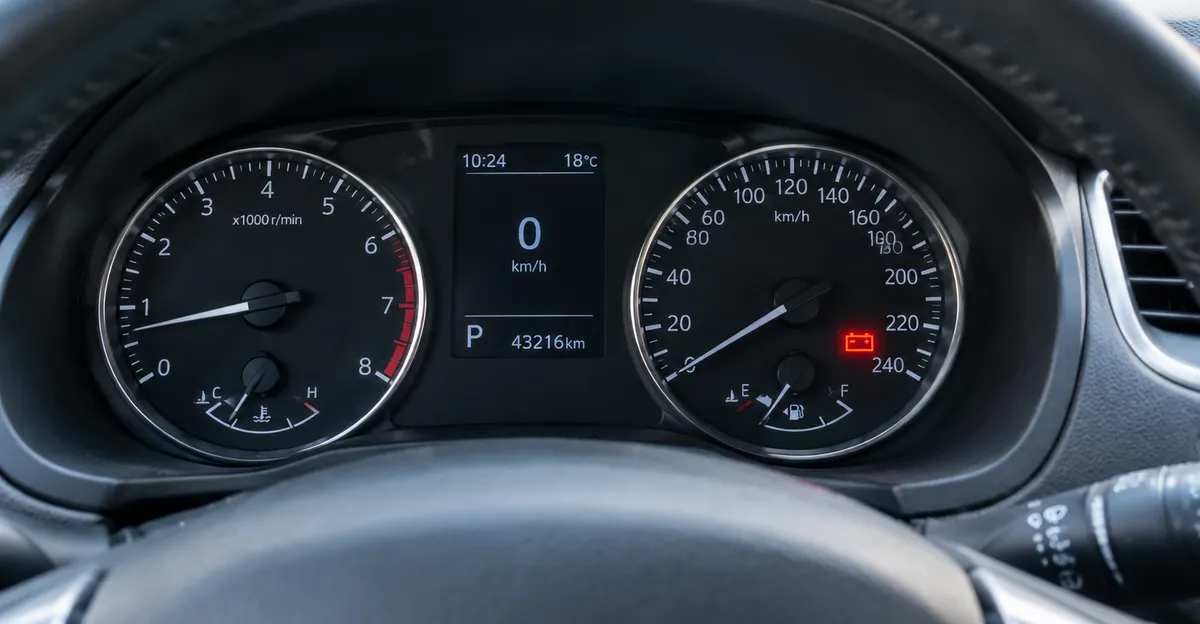
Why is my battery light on in my car is almost never a trivia question about the icon. It is the car telling you the charging system is not holding normal voltage while the engine runs. Why is the battery light on in my car after a cold start for one or two seconds is different: that brief flash is the self-check AAA describes, and it should go out on its own. A light that stays on, returns while you drive, or flickers with dimming lamps is the case this guide sorts.
You should leave with three decisions: whether to keep moving, what you can check safely under the hood, and what to ask a shop so you do not buy a battery when the fault is the alternator belt or a corroded cable. Nothing here replaces a voltage reading on your car. Approximate shop ranges below come from published guides, not from a bench test of your vehicle.
What the battery light is actually reporting
The battery icon is a charging-system warning, not a battery-health score. AAA’s charging-light article says that when the indicator stays on, the vehicle is depending on stored battery power and can only travel a limited distance before it shuts off. AAA Via’s alternator guide makes the same point from the other direction: once the alternator fails, the car runs on the battery until that battery is drained or damaged.
On modern cars the powertrain computer watches system voltage. AAA notes that the battery light may illuminate only when the computer sees an unusual difference between present voltage and the default it expects. That is why a weak battery that still starts the car can look “fine” until a charging fault is present, and why a healthy battery with a dead alternator still lights the lamp.
Les Schwab adds a short exception that confuses drivers: if the indicator goes away after a few minutes or after a restart, there may be nothing lasting to fix. Treat that as a temporary condition, not as permission to ignore a light that returns on the next drive. Firestone’s rule of thumb is clearer for the common case: a light that stays on while you drive deserves attention, and you will often notice sluggish power windows or a stereo that will not behave.
| What you see | What it usually means | First move |
|---|---|---|
| Light on for 1–2 seconds after start, then off | Normal charging-system self-check (AAA) | No action |
| Light stays on with engine running | Charging fault; car on battery power (AAA) | Reduce load; plan a short trip to a shop or a tow |
| Light flickers while driving | Intermittent charge: belt slip, loose cable, failing alternator (Les Schwab) | Same urgency as a steady light |
| Light never comes on at key-on | Bulb or charging-system fault (AAA) | Mention it at the next service |
| Light plus dim or overly bright lamps | Undercharge or overcharge from the alternator path (AAA Via) | Do not finish a long trip |
| Light after a jump-start | Jump did not fix charging; battery may still be empty | Test charging voltage before another long drive |
Internal links to warning lights help you sort icons that look similar in the cluster. A red battery shape is not the same job as a check-engine lamp, even when both turn on during the same failure.
What to do in the first ten minutes
AAA Via is blunt when the battery light comes on while you are already moving: pull over in a safe place and get the vehicle towed. The reason is traffic safety, not drama. If the alternator has failed, a stall in a travel lane is the risk. Continuing to drive can also cook a battery that is being drained hard, so you may replace both the charging part and the battery later.
Les Schwab’s softer version is still not a green light for a road trip: drive directly to a shop, or pull over and arrange assistance. Firestone lists the same stall and secondary-damage concerns. Use that shared floor this way:
- Turn off nonessential loads: rear defroster, seat heaters, high blower, phone chargers, and the audio system if you can still hear traffic.
- Keep the engine running until you are somewhere safe to stop. Restarting after a full shutdown may fail if the battery is already low.
- If you are on a highway with no exit soon, reduce speed, stay in a right lane, and aim for the nearest parking lot or shop rather than “just finishing the commute.”
- If headlights are already dim, the steering feels suddenly heavy on an electrically assisted car, or the car begins to surge and die, stop when it is safe and call for a tow.
Do not treat a successful jump-start as a repair. Les Schwab says you can jump a car with the battery light on, but if the alternator is the problem the car will not run for long. AAA Via adds that a jump after a stall is only a short window before the next stall. Towing is the safer default once the light has already proved the charging path is broken.
Why my car battery light is on while driving
Why my car battery light is on during a drive is the pattern AAA, Firestone, and Les Schwab all treat as a live charging problem. The engine is running. The lamp should be dark. It is not. Sort the moment by what else is happening, because the driver’s notes change which part fails first on the invoice.
| Pattern while driving | Likely path | What to tell the shop |
|---|---|---|
| Light comes on after a squeal from the belt area | Slip or failure of the drive belt that turns the alternator | Listen for belt noise; inspect serpentine belt and tensioner |
| Light plus dim headlights that brighten with rpm | Weak alternator output under load | Measure running voltage at idle and raised rpm |
| Light plus overly bright or flickering lamps | Voltage regulator or overcharge behavior (AAA Via) | Check for high voltage and a hot or swollen battery case |
| Light after hitting a puddle or rough road | Loose cable, damaged wiring, or intermittent belt contact | Wiggle-test cables with the engine off; inspect harnesses |
| Light only with many accessories on | Alternator cannot cover electrical load | Note A/C, heated glass, and lights that were on |
| Light returns after a short stop | Intermittent charge that a restart temporarily masks | Do not clear codes or ignore a returning lamp |
A burning smell from the engine bay belongs in the same conversation. AAA Via’s Travis Mock ties an electric burning smell to damage at the drive belt or the alternator itself. That is a stop-and-tow case, not a “see if it clears on the next highway stretch” case.
If the light is on and the car still feels normal, you are not “out of the woods.” AAA’s charging-light article says stored battery power is finite. How far you get depends on battery health, electrical load, and outside temperature. Nobody can promise you thirty minutes from the driver’s seat. Plan the next exit, not the next county.
Safe checks you can do without guessing the part
Shop pages agree on a short list of owner checks that do not require a rebuild of the alternator. Firestone and Les Schwab both start with corrosion and loose clamps. Do this only with the engine off, gloves and eye protection on, and baggy clothing and metal jewelry away from the battery. Batteries contain sulfuric acid. Les Schwab warns about that before any cleaning advice.
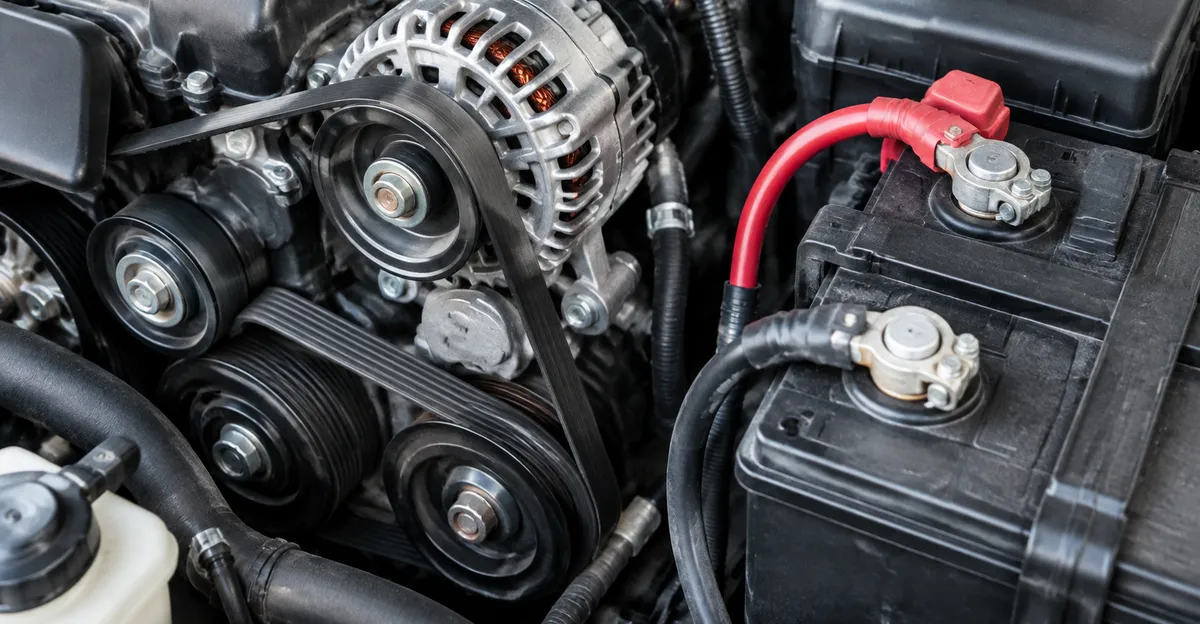
Open the hood and look at the battery terminals. White, blue, or green powder on the posts is corrosion. Firestone says it blocks conduction. Clean it only with a method your owner’s manual allows. Disconnecting the battery can wipe radio codes and other stored settings; Firestone notes that a memory saver may be needed. If you are not set up for that, leave cleaning to the shop and only report what you saw.
Wiggle the cable ends by hand with the engine off. A clamp that moves is a loose connection. Les Schwab says tighten a loose clamp so it sits snug. Do not overtighten a soft lead post. If a cable end is cracked or the insulation is melted, stop and have it replaced.
Look at the drive belt on a gas-powered car. Les Schwab lists cracks, glazing, and looseness as reasons the alternator may not spin correctly. A missing belt is an immediate tow. A belt that is wet and squealing after rain may recover once dry, but a light that stays on after the noise ends still needs a voltage test.
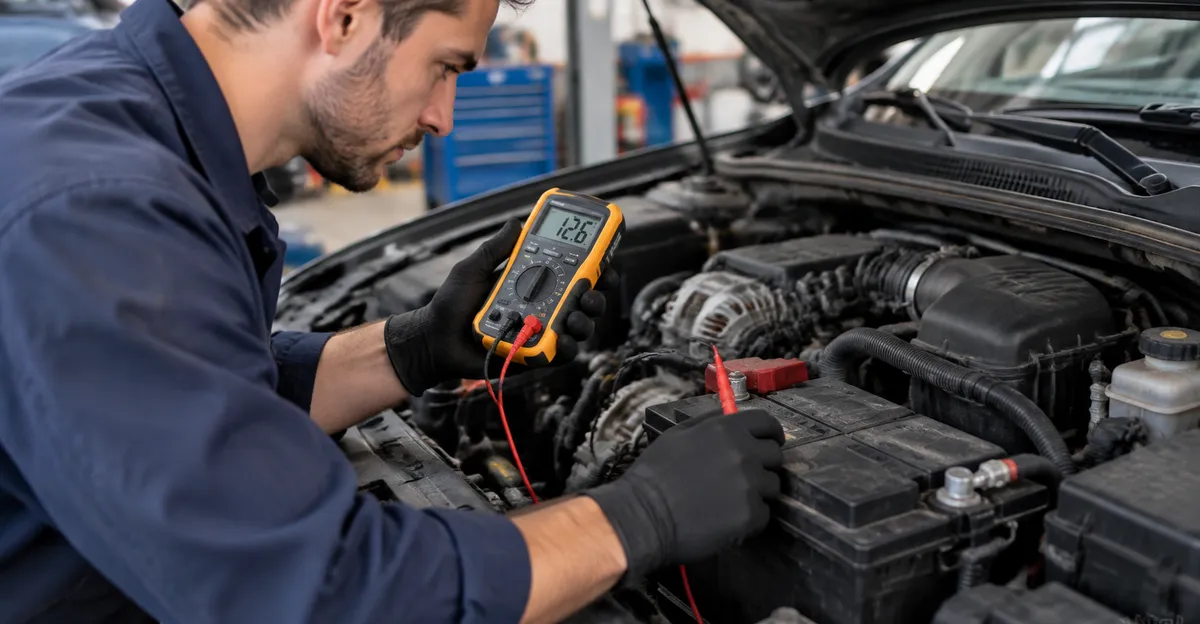
A simple multimeter check is the decision tool the shop pages keep returning to. Les Schwab cites under about 11.8 volts on a 12-volt battery as a dead or near-dead resting reading that needs charge or replacement. With the engine running, Les Schwab puts a healthy alternator roughly between 13.5 and 14.5 volts. Readings below that window point at charging trouble. Readings above a normal charging window can point at regulator or overcharge problems; AAA Via’s “overly bright lights” symptom belongs here. If you do not own a meter, that free battery check at a parts store or tire shop is the same idea: resting health plus charging output.
Do not stop at “battery failed” if the light was on while the engine was already running. AAA Via’s Mock says corroded cables can mimic a bad battery or a bad alternator. A full charging-system test is the point of the visit.
Why my battery light is on in my car: causes that actually light the lamp
Why my battery light is on in my car after the owner checks above usually lands on one of the items AAA lists: wiring issues, an old or bad battery, a faulty voltage regulator, a bad alternator, an electrical drain, or a worn belt that drives the alternator. Firestone and Les Schwab use the same cast of parts. The order matters for your wallet.
Alternator or regulator. AAA Via treats the illuminated battery light as a frequent sign you may need a new alternator. The alternator powers the car after start and recharges the battery. When it fails, the battery is the only remaining electrical store. A voltage regulator that fails open or closed can undercharge or overcharge. Overcharge can swell a battery case and create a sulfur smell; that is a shut-off-and-tow situation, not a DIY charge overnight.
Drive belt and tensioner. AAA’s cause list includes a worn or bad belt. Les Schwab ties broken or damaged belts to alternator issues. If the belt that spins the alternator also drives the water pump or power steering on your car, a belt failure can cascade into overheating or heavy steering. That is another reason not to “limp home” for thirty miles.
Cables, grounds, and visible wiring. Firestone and Les Schwab both put loose or corroded cables high on the list because they are common and sometimes cheap. AAA Via adds parasitic drain: electrical systems that keep drawing current after the car is off. A drain alone may not light the battery icon while you drive, but it can leave a battery so empty that charging behavior looks wrong after a short trip. Mention repeated dead mornings to the shop so they do not stop at a new battery.
The battery itself. Firestone notes that old, discharged, or weak batteries can contribute to the light, and that batteries often live three to five years depending on climate and use. Les Schwab flags batteries older than five years as replace candidates and recommends seasonal testing. Still treat the battery as one test result, not the whole story. AAA Via says a hard-to-start car needs the full charging system checked so you know whether the battery is bad or only empty.
Computer and smart charging. AAA’s newer-car note matters on late-model vehicles: the powertrain computer may set the lamp based on voltage strategy, not on a simple light bulb wired to the alternator. Stop-start and AGM systems change charging rules. If your car uses an AGM battery under a seat or in the trunk, say so. Wrong replacement chemistry is a separate failure mode covered on the battery part page and in battery-life guides.
Battery light versus a battery that will not start the car
Drivers mix two different mornings. One morning the car will not crank, the dash is dark, and a jump gets you going. Another morning the car starts fine, then the battery light stays on as you pull out of the driveway. AAA’s charging-light article is about the second case. The first case can be a battery that aged out, a parasitic drain, or a charging fault that emptied the battery overnight. The light during a drive is the car telling you charging is wrong in real time.
Use this split when you talk to a shop:
- No-start, no light while running after a jump: test the battery and look for a drain. Also verify charging voltage once it is running.
- Starts, light stays on: prioritize charging output, belt, and connections. Assume limited remaining battery range.
- Repeated no-starts after “new battery” installs: AAA Via’s warning about unfinished diagnosis applies. Cables and the alternator belong on the same ticket.
If the engine also shows a check-engine light or a “service charging system” message, AAA Via says that can appear with the battery lamp. Bring freeze-frame notes if the shop will share them. Clearing the message without a charging test just deletes evidence.
A swollen case, a rotten-egg smell at the battery, or a case that is hot to the touch is not a “drive to the store for a new battery later today” problem. Firestone and battery makers treat that as damage and overcharge risk. Shut the car down. Keep sparks and cigarettes away. Tow it.
What to ask for at the shop so you leave with the right repair
The shared advice on ranking pages ends at “get it tested.” The follow-up that still hangs is which test, in which order, so you do not pay twice.
Ask for a printed or verbal result that includes:
- Battery state of health or load-test result, not only “it starts.”
- Alternator output at idle and with electrical loads on (headlights, blower, rear defroster).
- A visual on the serpentine belt and tensioner.
- A check of cable ends and main grounds for corrosion or heat damage.
- A parasitic-draw check if the car keeps dying after sitting, even when charging voltage looks normal on a short driveway test.
If the battery fails and the alternator also fails, replace both only when the tests say so. AAA Via notes that running on a failing alternator can permanently damage the battery. That is a reason both parts can need work after a long limp, not a reason to buy both without numbers.
Ask whether your car needs a programming or battery-registration step after replacement. Some late-model charging strategies expect the computer to know a new battery is present. Skipping that step can leave odd charging behavior that looks like the light problem never left.
Get a road-test note if your light only appears at highway speed or only with the A/C on. AAA’s own self-check description is about key-on behavior. Intermittent highway faults need the same conditions the driver uses, the same way brake-vibration bulletins tell technicians to duplicate the customer’s road.
When a short drive to the shop is still the wrong call
Most shop blogs say “drive directly.” AAA Via says tow when the light is already on while driving. Reconcile those for your situation with risk, not optimism.
Tow instead of driving when:
- The light came on with dimming headlights, flickering dash, or a burning smell.
- You are in stop-and-go traffic where a stall blocks a lane.
- Outside temperature is extreme and you already needed a jump today.
- The belt is missing, shredded, or screaming.
- You are far from a shop and the battery was already weak.
A short drive with loads off can be reasonable when the light just appeared, the car still feels strong, and a shop is minutes away on surface streets. That is Les Schwab’s “drive directly” case. It is not permission to keep using the car until the weekend.
After a tow, do not jump the car “just to move it into a bay” without telling the tech the light was on. The restart can hide an intermittent belt or cable fault for the first minute of a bay test.
How this problem connects to battery age and other symptoms
A battery light is a charging complaint. Battery age is a capacity complaint. They meet when a weak battery is the last reserve after the alternator quits, or when a failing alternator keeps killing batteries. Use the battery part page for hold-downs, corrosion habits, and replacement chemistry. Use this page for the lamp that stays on while the engine runs.
Companion symptoms that belong in the same visit:
- Slow crank on cold mornings after recent light episodes.
- Headlights that pulse with engine speed.
- Accessories that reset or screens that reboot at idle.
- A sulfur smell or a hot battery case.
- A car that dies at a stop light after the light has been on for a while.
Those notes help a tech decide whether to prioritize charging output, connections, or both. They also keep you from treating a charging fault as a one-time dead battery coincidence.
For the broader cluster of dashboard icons, start at warning lights. For smells or noises that show up with charging trouble, the engine part page is the right column for under-hood follow-ups, not a reason to ignore the battery lamp.
FAQ
why the battery light is on on my car
AAA treats a battery or charging light that stays on while the engine runs as a charging-system fault: the car is living on stored battery power and can shut off after a limited distance. Causes include a bad alternator, a faulty voltage regulator, a worn belt, wiring problems, corrosion, or a drain. Have the charging system tested rather than guessing a battery-only fix.
why is my car battery light on
AAA Via quotes AAA Automotive Repair’s Travis Mock: a battery light means the vehicle is monitoring voltage and seeing a charging issue. The same light can also mean wiring trouble, a bad regulator, a worn drive belt, or a parasitic drain. Towing is safer than finishing a long trip once the light stays on while driving.
Can I keep driving with the battery light on?
Les Schwab says you may be running on battery power without a recharge, so the car can stop at any time depending on battery health. Firestone advises against commuting with the light on because of stall risk and further electrical damage. AAA Via recommends pulling over safely and towing when the light comes on while driving.
Is the battery light the same as a bad battery?
Usually not. AAA and Les Schwab list the alternator, regulator, belt, cables, and wiring alongside a weak battery. A dead battery often will not light the charging lamp by itself while the car sits. A meter on running voltage separates a battery that will not hold charge from an alternator that never puts charge back.
Why did the light go out after I restarted?
Les Schwab says a light that disappears after a few minutes or a restart may not be a lasting fault. Treat a one-time blip as a watch item. If the light returns on the next drive, or if lamps dim while it is on, return to the tow-or-direct-to-shop decision. Intermittent belt slip and loose cables often behave like a “cleared” warning.
Can I jump-start with the battery light on?
Les Schwab says yes, a jump is possible. AAA Via warns that after an alternator-related stall, a jump may only restore a short run before the next stall. Use a jump to reach a safe parking spot or a nearby shop, then test charging output. Do not treat a jump as proof the battery was the only problem.
What voltage should I see with the engine running?
Les Schwab cites about 13.5 to 14.5 volts for a healthy alternator with the engine running, and under about 11.8 volts as a dead or near-dead resting battery reading. Exact targets vary by vehicle and temperature. Use the reading to decide between battery service and charging-system service, not as a promise of remaining miles.