
By Automotive Research TeamUpdated 2026-09-23
Why Is My Car AC Blowing Warm Air
why is my car ac blowing warm air is a sorting problem, not a single broken part. The blower may be doing its job while the refrigerant loop is empty. The loop may be fine while a blend door dumps heater-core air into the vents. Or nothing moves at all because the fan never spun up. why is my ac blowing warm air in my car is the same complaint with the cabin already named: you feel heat where you asked for cold.
Start with what the vents are doing on Max AC, full cold, and recirculate. Strong warm air, weak cool air, no air, cold that fades after a few minutes, and a musty smell at startup are different jobs. why is my car air conditioner not working is the umbrella phrase shops hear first—it covers all of those patterns—so split the complaint before anyone opens a can. This page stays on the why and the next check. Leak repair, recharge pricing, and part quotes live on the car AC repair guide. Nothing here replaces a gauge reading on your car.
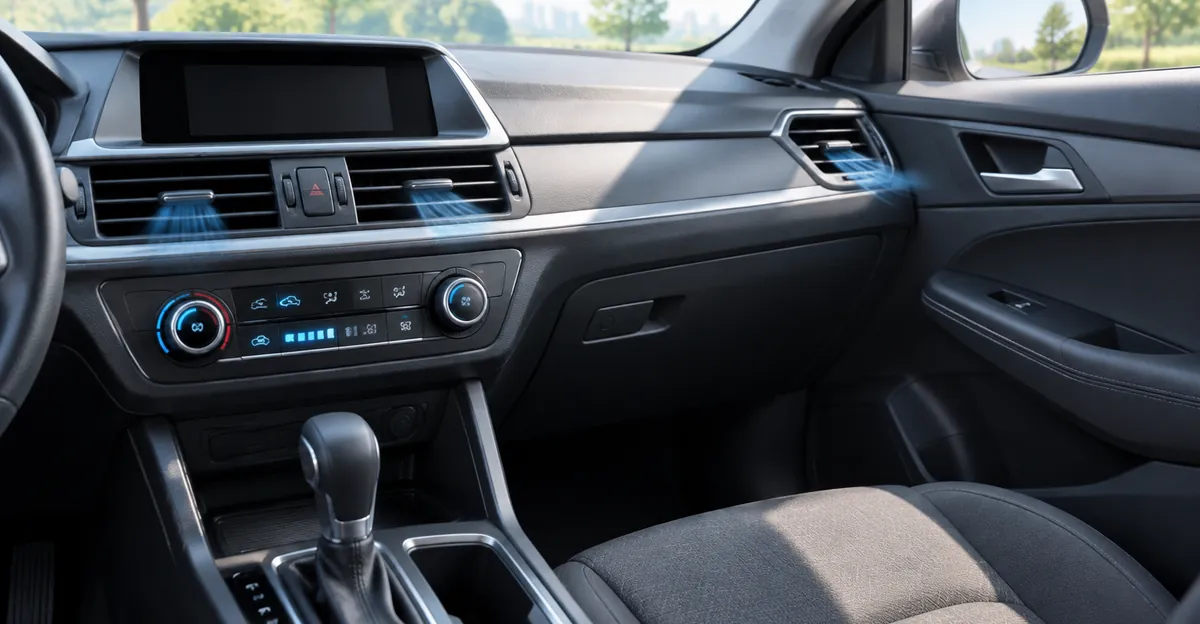
Strong Warm Air Versus Weak Cool Air
why is my car ac not blowing cold air is the lukewarm version of the same afternoon: air moves, but it never crosses from “not hot” into actually cold. why is my car air conditioner not blowing cold air names the same gap. AAA Club Alliance describes the system as a closed loop of refrigerant that a compressor and related parts move, with a blower pushing cabin air across a cold evaporator. When that loop cannot transfer heat, the fan still sounds busy and the cabin stays sticky.
Rule out the control panel before you buy a can. Fresh-air mode on a 100°F day with the temperature knob in the middle feels like a failure and is often just a setting. Recirculate keeps cabin air looping across the evaporator instead of pulling in more heat from outside. If the air goes cold only after you switch to recirculate and full cold, the loop was working and the setting was the problem. Write that down. It saves an unnecessary recharge argument at the counter.
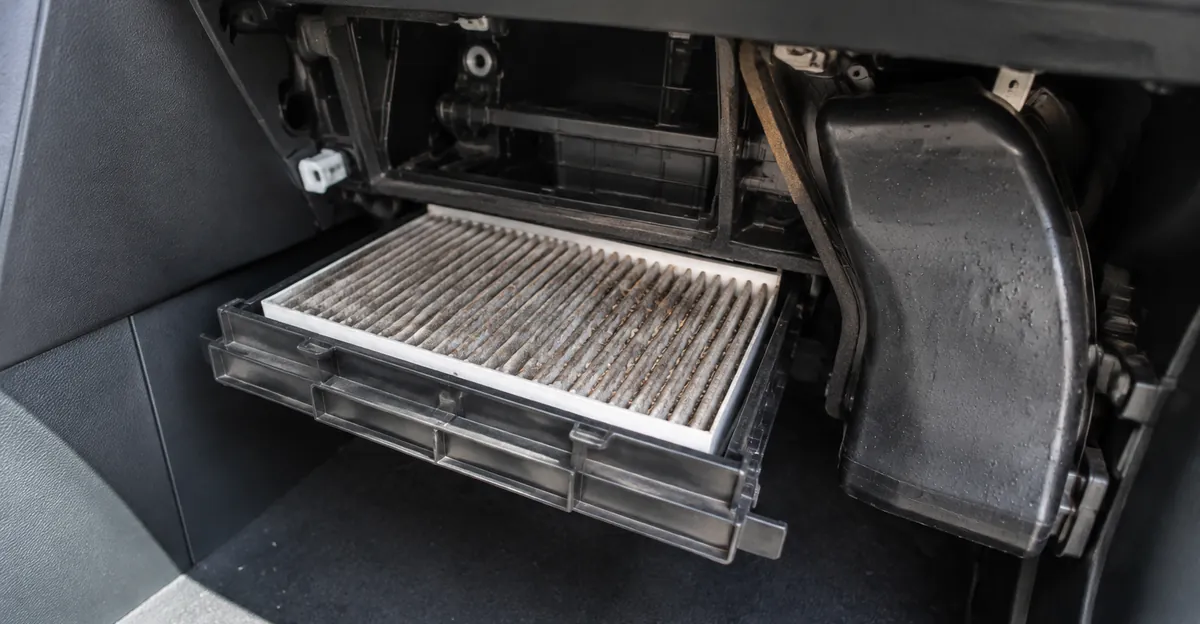
Volume and temperature are different measurements. Tires Plus notes that a dirty cabin filter restricts airflow and can make cooling feel weak even when refrigerant is present. American Auto Repair Center draws the same line: a clogged cabin filter mainly changes how much air you feel; strong airflow that stays warm points elsewhere. Put your hand at the center vent on high. Hard blast of warm air is a cooling problem. Soft whisper of air that is still cooler than outside is an airflow problem first.
One side cold and the other side warm is not a low charge by itself. American Auto Repair Center, citing Mobile Air Climate Systems Association guidance, notes that a blend-air door that never reaches full cold can let heater-core heat dilute the AC. Dual-zone cars make that complaint obvious. Recharging both sides will not move a stuck plastic door. Tell the shop which vent is wrong before they open a refrigerant can.
Why Is My Car Air Conditioner Not Cooling
why is my car air conditioner not cooling is the high-difficulty wording for the same heat-transfer failure. Cooling means the evaporator picks up cabin heat and the condenser dumps it outside. If either side of that exchange fails, the blower only moves cabin air. Compare vent air to outside air after a few minutes on Max AC. A small gap means the loop is barely working. A large gap means the loop is working and the complaint may be airflow, a door, or a setting.
EPA explains why DIY top-offs are a guess. Technicians cannot see how much refrigerant is already in the system when you arrive, so they may undercharge or overcharge—both hurt performance. Evacuation and recharge to the amount on the under-hood label is the measured path. EPA also states that anyone who services a motor-vehicle AC for payment must be Section 609 certified and must use approved recovery equipment. Intentional venting of refrigerant (except carbon dioxide systems) is illegal. Do not open a line to “let it hiss out.”
If you already used a parts-store kit, tell the shop what you added and whether the label matched R-134a or R-1234yf. Mixing refrigerants contaminates the system. EPA warns against adapters that force the wrong chemical onto a unique fitting. Bring the under-hood label wording with you.
When the Fan Works and the Air Stays Hot
why is my car ac blowing hot air is the complaint where the fan works and the temperature does not. why is my ac in car blowing hot air is the same seat-level report. AAA Club Alliance says AC that suddenly blows hot or warm air can mean a clog that stops refrigerant from flowing, or a compressor that is not holding pressure. Tires Plus lists a refrigerant leak as a common reason a car A/C blows hot air, and notes that refrigerant usually leaves as a gas, so you should not expect a puddle the way you expect oil or coolant.
Low charge is the everyday face of that leak. AAA’s repair advice names a refrigerant leak as the most common cause of a broken AC. EPA’s motor-vehicle air-conditioning guidance is blunt about what a top-off buys you: topping off or recharging can improve cabin cooling, and neither permanently fixes a leak. Repairing or replacing the leaking part is the option that lasts. If cold air returned after a can and faded weeks later, you already have AAA’s leak clue. Do not treat another can as the repair.
The compressor is the pump. Tires Plus calls it the heart of the system: if it does not circulate refrigerant, the evaporator never gets cold. AAA groups the compressor, condenser, and evaporator as the hardware that moves refrigerant and cools the air the blower sends into the cabin. A quiet clutch, a glazed belt on the engine, or a pressure switch that opened on a low charge can imitate a dead compressor. American Auto Repair Center makes the same point: warm air, cooling that comes and goes, or noise when the AC engages are clues, not proof that the pump itself is ruined. Measure before you replace the expensive part.
Condenser airflow is the other heat dump. Tires Plus places the condenser between the grille and the radiator. Leaves, bugs, or front-end damage can block the path. Expansion valves and orifice tubes restrict refrigerant into the evaporator. Tires Plus notes that a clogged valve or orifice tube can leave you with warm vents even when other parts look intact. That is a shop diagnosis with pressure readings, not a driveway guess from the seat.
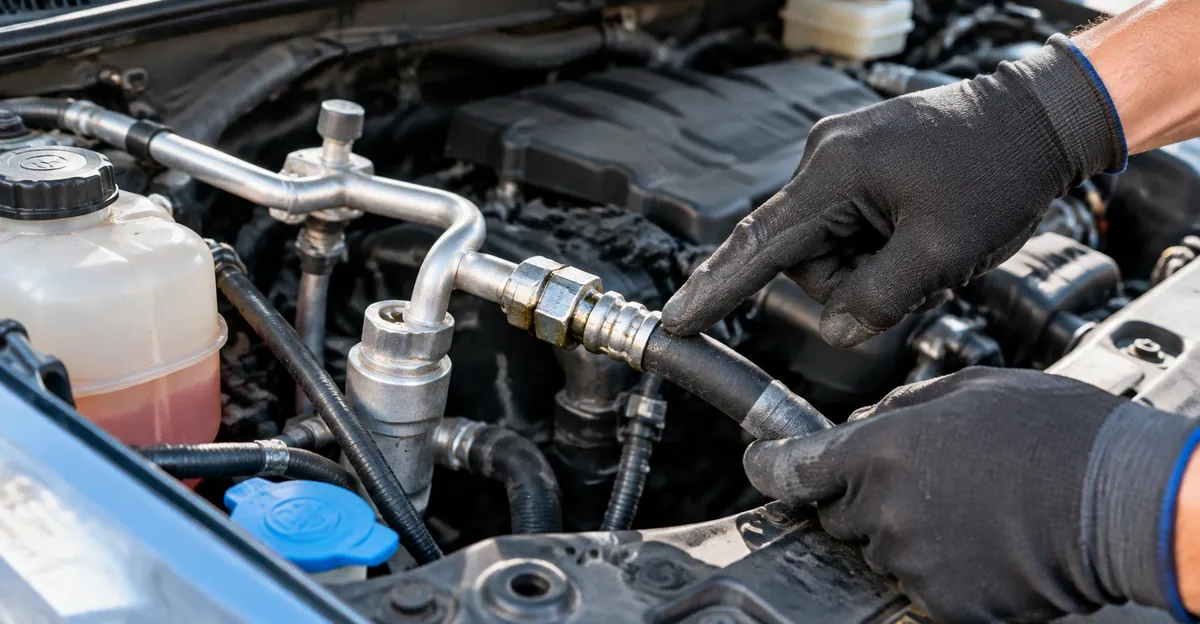
Do not confuse refrigerant with engine coolant. Warm vents from a low AC charge are not a reason to open the radiator cap. Coolant loss shows up as engine temperature, a low reservoir, or colored liquid. Refrigerant loss shows up as warm air and sometimes an oily film on a hose or fitting. Photograph oil. Do not wipe it off before the appointment.
AAA Club Alliance’s overview still holds for the belt path: belts and pulleys on the running engine power the compressor side of the system, so a glazed or missing belt can shut cooling down while the rest of the car drives. Debris in intakes or a clog in the refrigerant path can stop the system for a different reason. American Auto Repair Center lists the common mechanical and control causes in one place: low refrigerant, leaks, compressor problems, condenser airflow, cooling-fan failure, electrical or sensor faults, blend-door problems, and restricted refrigerant flow. That list is a diagnostic menu, not a shopping list. The row that matches your notes is the job.
AAA’s other recharge guidance, through Club Alliance’s consumer AC checkup piece, stresses a point drivers miss: a recharge is not a fix for every cooling problem. Dax Haak, director of Car Care Operations for AAA Club Alliance, is quoted saying issues can stem from faulty components or electrical problems, so diagnosis matters. If the system needs frequent recharges, treat that as a leak red flag. A healthy system should hold a charge for years; refrigerant is not gasoline that gets “used up.”
When the Vents Are Silent
why is my ac not blowing air in my car is a different invoice from warm air. No air means the blower never delivered cabin air across the evaporator. Refrigerant will not fix a silent fan. AAA Club Alliance lists poor airflow’s major culprits as a broken compressor in some contexts, clogged refrigerant tubing, a blown fuse, or a broken blower motor. Sit in the car with the engine running, fan on high, and listen. Silence at the vents with the fan commanded on is electrical or the blower itself. Stop the AC diagnosis there.
Tires Plus describes common blower failures: squeaks from the passenger-side floorboard, weak or absent airflow, intermittent speeds, and sometimes a burning smell from the vents. A resistor or control module that only allows one fan speed is still an airflow job. A cabin filter packed with leaves can starve the same motor. Pull the filter if you can reach it without forcing clips. If it is black and matted, replace it and retest before you approve a compressor.
The battery belongs in this split only when the car is also cranking slowly or other electrical loads are weak. The blower and the compressor clutch both need power. A weak battery does not turn cold refrigerant hot. It can keep the fan or the clutch from running. Say that at the counter if it is true. Do not let a slow crank become an automatic AC parts order.
Debris in intakes is on AAA’s list too. Leaves in the cowl under the windshield wipers can choke recirculate or fresh-air paths. That is a cleaning job if the blower still spins. It is not a reason to evacuate the refrigerant loop.
If air returns after you jiggle the fan switch or tap under the dash, you still need a durable fix. Intermittent blowers fail in heat and leave you without defrost moisture control on a humid commute. Treat no-air as a safety comfort issue in rain, not only as a summer luxury.
Cold at First, Then Warm—or Only on the Highway
why is my car a/c blowing warm air also shows up when people mean “cool at first, then warm.” Timing and speed matter more than a single part name. American Auto Repair Center lists useful details: how long the air stays cold, whether traffic makes it worse, whether highway speed helps, whether a restart restores cooling, and whether one side stays colder. Bring those notes. A system that is cold for three minutes and then warm is a different test than a system that never cools.
Cold for a few minutes, then warm often tracks a low charge, a clutch that drops out, an overpressure cutoff, or an evaporator that ices and then blocks airflow. Ranking shop pages describe the same fork: intermittent cooling is not proof the compressor is ruined, and it is not a reason to keep adding cans until the cabin feels right for one afternoon. Time the cold window. Note whether a restart restores it. Say whether the fade happens at idle, in traffic, or after a long highway run.
Cool on the highway and warm at a stop light points at condenser airflow more than at a random hose. American Auto Repair Center adds the driving pattern worth naming at the counter: cool while moving, warmer at idle often means the electric cooling fan is late or dead, because at low speed the car needs that fan to push air across the condenser. Look through the grille. Tell the shop if the problem started after a bumper tap. Watch for fan engagement at a stop with the AC on. If the temperature gauge climbs when the AC is requested, switch the AC off and treat that as an engine-cooling path, not a cabin-comfort can.
These two patterns sit next to each other because both tempt a top-off. EPA’s point still applies: a top-off cools until the leak or the airflow problem returns you to warm vents. Ask for a pressure and leak check when cold fades after a recharge. Ask for a cooling-fan and condenser check when cold only appears above a certain road speed.
Musty Startup Smell Versus a Cooling Failure
why does my car air conditioner smell is often a mold question, not a refrigerant question. AAA Club Alliance ties dank, musty smells—especially when you first turn the AC on—to mold and mildew collecting on a malfunctioning evaporator. The evaporator sits in the HVAC case behind the dash. It runs cold. Condensation is normal. That water should drain under the car. When moisture lingers on the coil, the cabin gets a gym-bag odor for the first minute of every drive.
Smell and warm air can travel together or separately. Warm air with no odor is still a cooling-loop or door problem. Cold air with a musty blast at startup is an evaporator hygiene and drain problem. Approving a compressor because the cabin stinks is how you pay for the wrong job. Ask the shop to confirm the drain is open, the cabin filter is dry and clean, and whether an evaporator cleaning treatment is on the estimate before any refrigerant work.
Other odors need different words at the counter. A burning smell from the vents with weak airflow points back toward a blower or electrical heat, which Tires Plus lists among blower-failure signs. A sweet smell with an overheating gauge is coolant, not AC mildew. A sharp chemical bite after a DIY can may be refrigerant or sealant additives—say what you sprayed. Do not sit in a closed garage with the system running while you “sniff test” chemicals.
Simple habits help after a wet commute: run the fan on fresh air with AC off for a few minutes before you shut down so the evaporator can dry. That is not a substitute for a clogged drain or a soaked filter. If the odor returns every morning after the car sits overnight, you are describing the pattern Volkswagen and other makers document in odor bulletins: smell after several hours unused, within the first minute of startup. That pattern belongs on the repair order.
What to Check Before You Call a Shop
Competing pages all say the same floor: low refrigerant from a leak, compressor or condenser trouble, weak airflow from a blower or filter, and musty smells from a damp evaporator. After that floor, you still have decisions the short lists leave hanging. Use this table to turn the complaint into a sentence the service writer can act on.
| What you notice | Likely path | First check |
|---|---|---|
| No air on high | Blower, fuse, resistor, or clogged filter | Listen for the fan before any refrigerant talk |
| Strong air, warm at every vent | Low charge, compressor not pumping, clog, or condenser airflow | Max AC, recirculate, full cold; then oily film under the hood |
| Cool on the highway, warm in traffic | Cooling fan or condenser airflow at idle | Watch for fan engagement at a stop |
| Cold for a few minutes, then warm | Low charge, clutch dropping out, or control issue | Time how long cold lasts; note if a restart helps |
| Driver cold, passenger warm (or reverse) | Blend door or dual-zone actuator | Compare vents; do not recharge first |
| Musty blast at startup, then normal | Evaporator moisture / drain / filter | Cabin filter and drain; smell is not a leak by itself |
| Cold returned after a can, then faded | Leak still open | Leak check; EPA: top-off is not a permanent fix |
Before you call, run this short list. These are observations, not a repair. If you are unsure under the hood, stop and let the shop look. Refrigerant can injure skin and eyes.
- Engine running, fan on high, temperature full cold, recirculate on. Is air moving? Same at both front vents? Cooler than outside or not?
- Did cooling fade weeks after a recharge, or did it never return? Frequent recharges are AAA’s leak flag.
- With the engine off, look for oily film on hoses, the compressor body, and the condenser face. Photograph it. Do not wash it off.
- Read the under-hood refrigerant label. Match any can to that chemistry. No adapters.
- Note idle-versus-highway behavior, how long cold lasts, and any musty startup smell.
- If the warning lights include an overheating gauge or a check-engine light that appeared with the AC complaint, say so. Overheating is not an AC odor job.
Ask the shop three questions the floor articles rarely script for you: Where is the leak or the failed control, in writing on the estimate? Are you Section 609 certified for paid refrigerant work? Are you quoting a top-off, an evacuate-and-recharge to the label amount, or a part replacement plus recharge? EPA’s options page is the reason those three are different products.
When Warm Air Becomes a Repair Decision
Once you know whether you have no air, strong warm air, a smell, or a fading recharge, stop averaging strangers’ cars. The next step is a leak check or an electrical check, not a second can because the first one felt better for a weekend. EPA does not require leak repair before a charge under federal rules, and some states or cities may; ask before you pay. EPA still recommends fixing the leak if one is found, because another top-off only returns you to this page.
Belt noise when you request cold, a compressor that never clicks, or cooling that only appears above certain engine speeds belongs in the notes for the engine bay inspection. A dead blower belongs with fuses and the resistor pack, not with the condenser. A musty evaporator belongs with drain and filter service. Keep those lanes separate on the estimate.
For recharge ranges, leak-find methods, condenser versus hose labor, and what a Section 609 shop should put on the invoice, use the car AC repair page. This article’s job ends when you can name the symptom row and refuse a parts order that does not match it.
FAQ
why does my car air conditioner stink
AAA Club Alliance ties dank, musty cabin smells—especially at AC startup—to mold or mildew collecting on a malfunctioning evaporator. That is a moisture and hygiene problem on the cold coil behind the dash, not proof that refrigerant has leaked. Ask the shop to check the evaporator drain, the cabin filter, and whether an evaporator cleaning treatment is appropriate before you approve a refrigerant-loop repair.
why does my car air conditioning smell bad
A musty or sour smell usually means condensation is lingering on the evaporator instead of draining under the car. AAA lists musty smells as a reason to see a mechanic. A sweet coolant odor, a burning smell from the vents, or a sharp chemical bite is a different path—those are not the same as evaporator mildew. Describe the odor and when it appears so the shop does not treat every bad smell as a refrigerant job.
why isn't my car ac blowing cold air
AAA Club Alliance says sudden warm or hot air often points to a refrigerant-flow clog or a compressor that is not holding pressure, while weak airflow more often tracks a blower, fuse, or debris. Confirm Max AC, full cold, and recirculate first. If the fan is strong and the air is still warm, expect a pressure and leak check. If the fan is silent, stop chasing refrigerant and find why the blower is dead. EPA notes that topping off cools the cabin only until the leak empties the system again.